





![AAVS Jordan 2013, "Desert Ecologies." [uto] Group 01.](../../../../wp-content/uploads/2014/01/AAVS_Jordan_Outcomes_uto_Group1_03_FRONT.jpg "AAVS Jordan 2013, \"Desert Ecologies.\" [uto] Group 01.")
london UNITED KINGDOM
AA Visting School Jordan 2013
director: Riyad JOUCKA
suckerPUNCH: Describe your project.
AAVS Jordan 2013 (Riyad JOUCKA, director): AA Visiting School Jordan 2013 was an intensive research program dedicated to the mimicry of natural formations evident in desert ecologies.
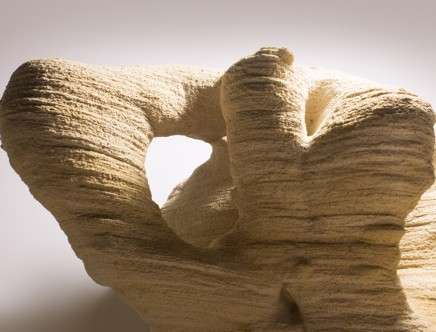
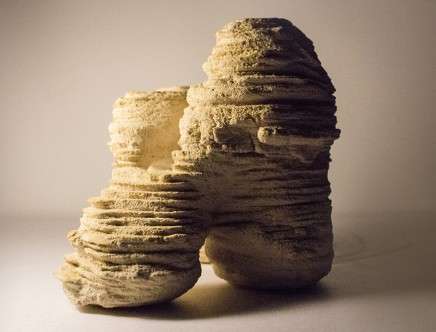
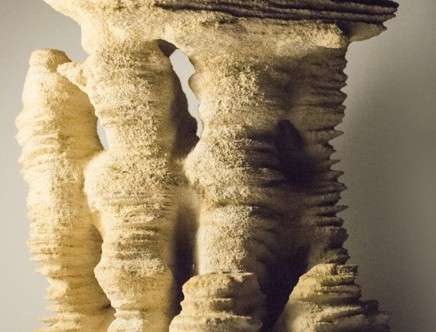
The workshop proposed rethinking the process of developing architectural interventions within the Jordanian desert. Set within the dynamic city of Amman, the rose-rock carved city of Petra and the echoing desert of Wadi Rum.
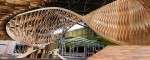
The context of the south Jordan desert ecology was used as a precedent to experimenting with material processes in architectural design. Geological formations of Jordanian landscapes had a major impact on the outcomes of this research. The group started their exploration with a trip to Wadi Rum and Petra, to document the natural and man-made materializations within the Jordanian desert. Computational design tools were used to script logic systems that generated formal iterations, following certain programmatic functions of interventions planned by the students within fore-mentioned sites.
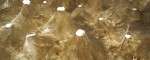
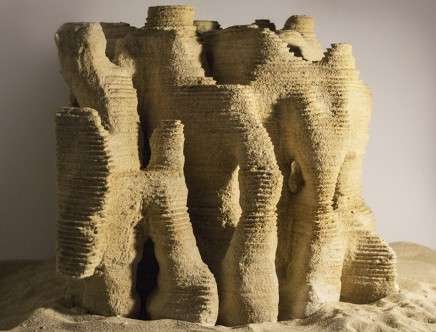
Improvising on additive processes such as Analogue 3-D printing with sand, the Co-de-it unit simulated shelters that are nestled within the natural environment of the Jordanian desert with minimal interference. Scaled models of these were prototyped using ad-hoc technologies and innovative materials. The consistency of sand as an efficient and available building material, as well as the coherence and fluidity of the geometries used was part of the group’s strategy to introduce minimal-impact interventions with the serene environments of the desert.
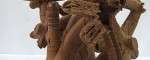
The [uto] unit planned at the larger scale of urban settlements. These were to be robotically excavated directly onto the topography of the desert and would have forms that regulate their interiors in a passive manner. CNC Milling on natural Jordanian limestone was attempted to represent scaled models of these ideas. Carving directly onto the face of the desert topography, the group simulated settlement patterns that emerge with no preconceived notions of top-down urban planning.
We present this work as an insight to the value of innovation in computational design and material experimentation. It is an emergent exertion of international and Jordanian professionals, students and academics that collaborated within 10 days to produce these outcomes.
Additional credits and links:
Directed by: Riyad Joucka
Marketing and Management: Farah Ragheb
Tutors: [uto] Unit (Austria): Ursula Frick, Thomas Grabner; Co-De-It (Italy): Alessandro Zomparelli, Tommaso Casucci.
Students:
[uto] Unit:
Abeer Seikaly
Ammar Ghazal
Diyaa Abu-Eisheh
Hammed Al-Mutawa
Luma Ifram
Muhammad Abboudeh
Muneerah Alrabe
Nick Tyrer
Nizar Taha
Omar Qubain
Rida Qurashi
Sima Oklah Al-Zou’bi
Stephanie Yacoubian
Co-De-It:
Adeen Ghaith
Agata Kurzela
Ban Edilbi
Farah Mudhefer
Hashem Joucka
Mahmoud Aref
Mohammad Al-Majed
Morad Alzaghal
Sarah Hussein
Shahad Farouk Ghafoory
Sounia Al Nimri
Suha Hasan
Tala Fasheh
Zeid Madi
Special thanks to our material sponsors:
D-Shape
Sharkeyoon Art Stone