







los angeles CALIFORNIA
SCI-Arc
critic: Andrew ZAGO.
suckerPUNCH: Describe your project.
Xiaonan YANG: Depending on the position of observing object, the result could be different.
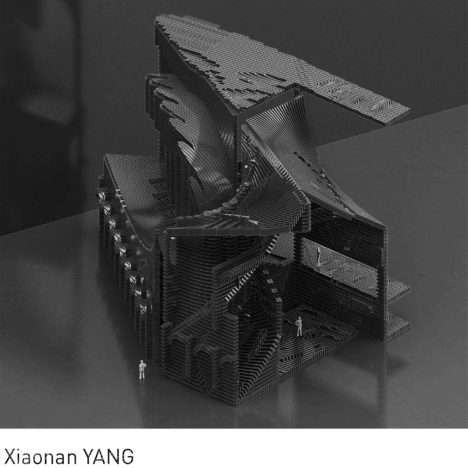
- Xiaonan YANG, “2D Depth.” Model Photo.
- Xiaonan YANG, “2D Depth.” Analytic Drawing 1.
- Xiaonan YANG, “2D Depth.” Analytic Drawing 2.
- Xiaonan YANG, “2D Depth.” Analytic Drawing 3.
- Xiaonan YANG, “2D Depth.” Analytic Drawing 4.
- Xiaonan YANG, “2D Depth.” Perspective 1.
- Xiaonan YANG, “2D Depth.” Perspective 2.
Object shift from a
hovering perfect flat plane to a bent and curved continuous surface of light and shadow which
allowing the brain to exist in blurred states…between 2 and 3 dimensions, between darkness and
light, between compression and expansion, between knowing and not knowing. As the beginning
of architecture as a profession, making drawing in two dimension to expressing spatial
relationship in three dimension world and finding ways of construction is the crucial job of
architect. It is the most important process that how does the translation happen from the 2d
drawing to the 3d space or reverse. Especially during the process of design the huge amount of
information missing brings the consequence of vague explanation and self-misreading. These
mistakes are the impact that pushes the design forward.
2D Depth is a description of the dubious condition of contents translating between 2d and 3d.
Lines stay in diverse forms simultaneously. It bears a unique topography of striating lines, gaps
and folded operating on planes. In addition the multiple position of drawing plane would
participate into the translation course as well. From the same point of view, since there are too
many explanations which are tenable so that it is hard to tell the correct condition, in other hand,
all answers are both right and wrong. Along with the change of position, the form varies
continuously which brings the time dimension into the object. 2D Depth allows us to see the eyes’
inherent limitations as well as the excess of what they produce on their own. Faces disappear and
again reappear. Forms are hidden and revealed.
This design is trying to bring a new exhibition area in West Smithfield Market for Museum of
London. Since the context is full of historical meaning and already left deep memories, the most
important concept of this new addition building is to establish new exhibition space and to keep
the spatial logic of the original building at the same time. The project takes the existing building’s
plan, elevation and section as the 2D start. Using these noticeable 2D elements the new 3D space
relationship is built. Then the image information from perspective view of existing building is
projected on to this new 3D object to create vaguely familiar details variation on the new building.
This projected 2D then can generate even more in next level. By doing this when audience
experiencing this new museum their memories would always be recalled. It is hard for them to tell
which part of the museum is new because everything thing seems to be like a Déjà vu. Audience
need to keep changing their position to confirm their observation that fights with memory. The
museum itself becomes the most valuable exhibit that carrying the extremely varied history.
sP: What or who influenced this project?
XY: Gustavs Klucis’s graphic design, Erwin Heerich’s abstract drawing and sculptures, Glitch art, Lygia
Clark, Jonathan Lasker’s Painting, Alvaro Siza, Rudolf Arnheim, London traditional buildings.
sP: What were you reading/listening to/watching while developing this project?
XY: Reading: Art and Visual Perception by Rudolf Arnheim, Listening: Trap and EDM.
sP: Whose work is currently on your radar?:
XY: Frank Gehry, SO-IL, Marcelo Spina, Steven Holl
