








new york NEW YORK
Columbia GSAPP
Critic: Mark WASIUTA & Eduardo TAZON MAIGRE
suckerPUNCH: Describe your project.
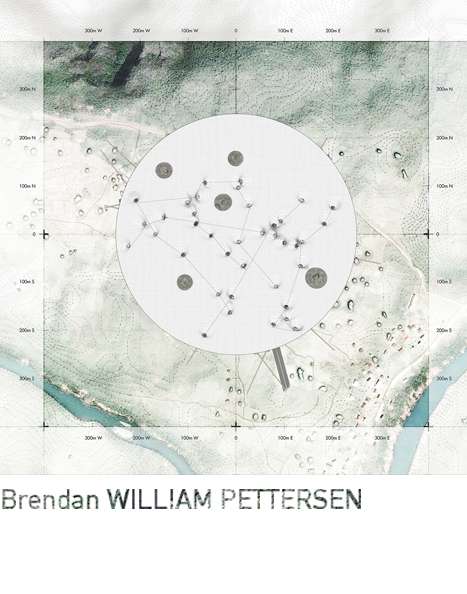
Brendan WILLIAM PETTERSEN: The proposed design is a crater-collecting apparatus whose purpose lies between an active archaeological site and a memorial.
- Brendan WILLIAM PETTERSEN, “Landscapes of Obscured Conflict: A Topographic Legacy.”, Axon
- Brendan WILLIAM PETTERSEN, “Landscapes of Obscured Conflict: A Topographic Legacy.”, Axon
- Brendan WILLIAM PETTERSEN, “Landscapes of Obscured Conflict: A Topographic Legacy.”, Perspective
- Brendan WILLIAM PETTERSEN, “Landscapes of Obscured Conflict: A Topographic Legacy.”, Perspective
Produced in an academic studio extending Columbia GSAPP’s “Collecting Architecture Territories” initiative and in fulfillment of university-funded independent traveling research, this project is predicated on a claim: war is an act of design. Architecture can substantiate this claim through manipulations of space, material, structure, and light illuminating invisible histories responsible for warfare’s archaeological remains. If acts of warfare are also acts of design, their logics must bear the capacity to guide architectural designs forensically reconstructing these acts.
During the Second Indochina War, Laos, Vietnam, and Cambodia sustained tens of millions of United States Air Force (USAF) bombing sorties. The US National Archives and Records Administration (NARA) accounts for most of these sorties in a dataset detailing their coordinates, mission dates, aircraft models, ordnance models, quantities of ordnance in weight and number, and bomb damage assessments. Manually compiled from printed sortie reports, together these data frame bombing as a process of specification. As evidenced in this dataset and its corresponding topographic results, these bombings yielded substantial alterations to their targeted sites’ geomorphic characteristics at a degree of specificity not dissimiliar to land art but at a scale of physical and political impact never before seen in self-consciously artistic practices. Marking the trauma these territories and their people suffered for over nine years and continue to do so under the threat of unexploded ordnance, fields of bomb craters stretch for hundreds of kilometers, together constituting what may unintentionally be the world’s largest work of land art.
In Ban Sènphan, a small Lao village in Khammouane province within which the design proposal tests the project’s underlying claim, several hundred of these bomb craters coexist with monumental limestone cliffs and houses fabricated from ordnance scraps. Laos, whose countryside along the Vietnamese border hosted a crucial segment of the Ho Chi Minh Trail, especially displays the lingering consequences of violent acts Americans performed over forty years ago. The millions of sorties responsible for bomb craters on Lao soil-every eight minutes, twenty-four hours a day-operated under the guise of the CIA’s Air America, a dummy corporation posing as a passenger airline in Thailand. The Ho Chi Minh Trail, one of military history’s most extensive engineering feats and the target of Air America in Southern Laos, delivered North Vietnamese soldiers and supplies to South Vietnam through a complex network of routes across Laos and Cambodia that included Ban Sènphan.
The proposed design is a crater-collecting apparatus whose purpose lies between an active archaeological site and a memorial. It acknowledges the alien nature of Laos’ bomb craters by presenting a resultant architecture disengaged from the local vernacular and wholly dependent on the logics of the craters’ formation. Gridded representations defining this territory, once used to provide coordinates for USAF bombing sorties, become spatial devices that enclose, expose, and measure craters. This strategy facilitates the preservation and study of the artificial topography’s historical and future conditions alike.
Recipient of the William Kinne Fellows Traveling Prize and the Lowenfish Memorial Prize, May 2017
