





cambridge MASSACHUSETTS
Harvard GSD
Critic: Jennifer BONNER
suckerPUNCH: Describe your project.
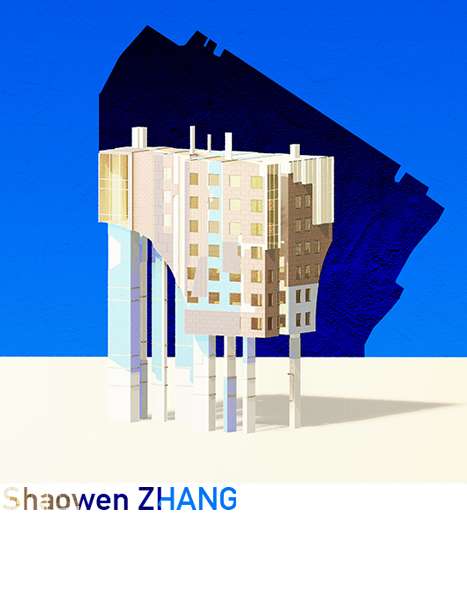
Shaowen ZHANG: The thesis begins by taking an object of reference from visual-material cultures - a Neolithic Austrian cave sketch which renders an excess of lines – to develop a method of form-making through pattern stroke simulations.
- Shaowen Zhang, “Same Types, Special Characters: Another Mall for America.”, Elevation
- Shaowen Zhang, “Same Types, Special Characters: Another Mall for America.”, Elevation
- Shaowen Zhang, “Same Types, Special Characters: Another Mall for America.”, Elevation
- Shaowen Zhang, “Same Types, Special Characters: Another Mall for America.”, Elevation
- Shaowen Zhang, “Same Types, Special Characters: Another Mall for America.”, Interior Perspective
- Shaowen Zhang, “Same Types, Special Characters: Another Mall for America.”, Interior Perspective
- Shaowen Zhang, “Same Types, Special Characters: Another Mall for America.”, Model Plan
- Shaowen Zhang, “Same Types, Special Characters: Another Mall for America.”, Model Plan
By exploring first the potential of working with line type, brush stroke, patterning, scale and translation from and within the drawing, a proto-image emerges. Then, by attempting to enact compositional, organizational, and spatial conditions out from the proto-image, a series of proto-architectures emerge. Such a collection of proto-architectures is the vocabulary to be schematized accordingly. This internal process simulates the rules of its own making, bringing forth a lexicon of special characters to be paired with generic archetypes, to be inscribed into New Urbanism’s architectural image.
Through such groupings, characters are made compound by means of ubiquitous façade codings, taken from what the corporate aesthetic would seem to imply: the same curtain wall articulation borrowed from the BB&T tower down the street, for example. From this propagation, an image of self-similarity arises in full. These taxonomical drawings represent the new image of contemporary hybridity – again, a making compound – and seeks to break down the distinction between same types, special characters, as well as their presumed cultural purchase. As a reaction to how the shopping mall today either resists or takes full part in the aesthetic regimes of late capitalism, the thesis ultimately seeks to challenge, amplify, and provoke the limits of New Urbanism’s architectural-aesthetic image by combining a borrowed-once-again syntax with the simulated new-languages generated from working methods outlined above. To do so is to introduce a novel cast of figures typical of contemporary American eclecticism and to re-insert them back into a once salient cultural emblem.
