






columbus OHIO
Knowlton School of Architecture at The Ohio State University
Critic: Sandhya KOCHAR
suckerPUNCH: Describe your project.
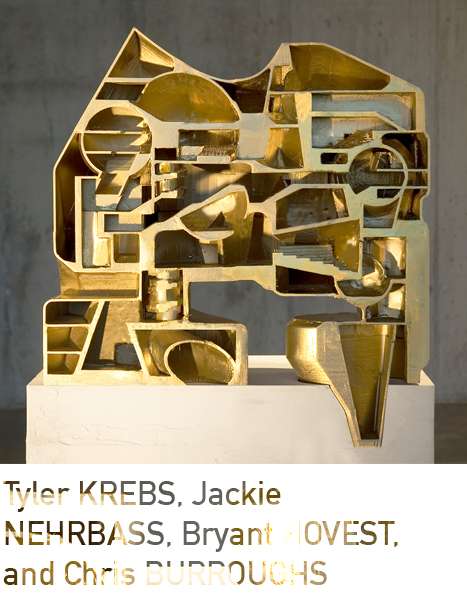
Tyler KREBS, Jackie NEHRBASS, Bryant HOVEST, and Chris BURROUGHS: We studied texture mapping and its ability to translate across dimensions. This computer generated process samples everyday objects and turns them into what we call space bashed parts; a further development of kit bashing, where the whole is both defamiliarized yet leaves the Ness-ness of the original object in tact. The interior qualities become of more critical importance than traditional kit bashing.
- Tyler KREBS, Jackie NEHRBASS, Bryant HOVEST, and Chris BURROUGHS, “Ness-Ness.”, Model Photo
- Tyler KREBS, Jackie NEHRBASS, Bryant HOVEST, and Chris BURROUGHS, “Ness-Ness.”, Model Photo
- Tyler KREBS, Jackie NEHRBASS, Bryant HOVEST, and Chris BURROUGHS, “Ness-Ness.”, Section
- Tyler KREBS, Jackie NEHRBASS, Bryant HOVEST, and Chris BURROUGHS, “Ness-Ness.”, Axons
Our project puts forth question as to how is the historical discourse on the relationship between form, content and the in-between condition of the medium relate in contemporary ways? If everything is architecture as Hans Hollein states, how do we bring in a level of expertise to the discussion?
To test this we created a catalog that takes a series of familiar objects such as the cross, the house, the sphere, the cylinder, the ice cream cone etc. and and we applied digital methods of texture mapping (surface and space), form and render (medium) to study this historical relationship of form and content.
The catalog documents its own morphogenesis wherein the original object is hybridized through an application of texture mapping and its representations. We selected the hamburger to be the quintessential “American” object, because of its ubiquity and its spatial composition. The catalog puts forth a series of questions: What happens when a hamburger texture map/image is applied to an everyday object? How do we now read the object? How do we read material specificities? How do we translate a two dimensional texture map, into three dimensions? How do we read space? How do we read the constructed assemblies? How do we read the collisions of material? How do we read the seams when the lettuce collides with bun? Can the texture map swell into 3 dimensions? Can the elements of the hamburger and the cross travel to produce a quality of “ness-ness?” Our catalog produces new methods of translations from 2D to 3D: a texture map into an object.
The texture map becomes the origin myth for the everyday object.
Its agency is its ness-ness.
It guides form.
It provides detail.
It substitutes primitive geometries when elements become too recognizable.
It re-territorializes form.
It de-familiarizes.
It selects techniques such as draping that strengthen its agency.
It operates in the liminal simultaneously both interior and exterior, operates in the transitions/intersections of geometries.
It produces a congealed object, a space-bash. This space-bash differs from its contemporary counterpart “the kit-bash” which is non-spatial, an assemblage of seemingly unrelated parts.
The project of ness-ness rejects the anxiety of the free plan.
It rejects the modernist idea of the warehouse.
It creates local spatial identities and specificities.
It creates fragmentary or deliberately incomplete architectural elements.
It produces spatial difference.
It produces the spatial spectacle.
It speculates on new subjectivities of space both in terms of the politics and performance.
We have created 4 artifacts that deploy the ness-ness: The house-ness, the elephant-ness, the tower-ness and the city-ness. Content has been added through program, scale, figure-ground relationships, etc. Program is projected through evaluating the predisposed qualities of the original shape with the new space bashed qualities.
HOUSE-NESS
The House-ness project uses play and intersections of the space-bash to question what a house is? It offers no typical plan, in fact it is not interested in the plan. It explores the section, the in-between spaces and the intersections between objects. It questions its counterpart: the mass produced Maison Dom-ino wherein economy dictates a typical spatial arrangement. What if this house-ness could instead allow for frivolity instead of unction? It prods at established conventions and habits of dwelling.
ELEPHANT-NESS
The elephant has strong architectural connotations, in particular with the work of Jean-Jacques Lequeu who knew how to raise the ordinary to something extraordinary. Our projects asks broader questions of what does the inside of an elephant look like? Is its interior as fun as the exterior? The interest in Lequeu’s project lies in the reconciliation of a discrete form with a malleable program. Our new elephant plays on familiarity, and tethers the line between a recognized elephant and something completely different on the inside.
TOWER-NESS
The cylinder applied with the burger texture map becomes a stack of burgers and transforms into a tower. Our method for generating space is not just limited to one scale, and the coded cylinder has the potential of being endless. Our method creates and shapes new worlds. This generation of space/form can encapsulate new spaces of living as well create new spaces that agglomerate.
DONUT-NESS
The next condition that our technique provides is a city-ness. Taking the form of a donut and applying our process created a series of intersecting spaces that organizes the city in ways that were previously not possible. It provides the opportunity to describe a city using words like array and conglomeration which allows for new interpretation of spaces. These space-bashed spaces are simultaneously dependent yet separated from one another, a variety of scales allows for a collision of worlds within one larger piece.
To conclude, the texture map of the hamburger has potentials to produce new 3d worlds.
sP: What or who influenced this project?
TK, JN, BH, and CB: Hans Hollein influenced the project.
and the idea that “everything is architecture”.
sP: What were you reading/listening to/watching while developing this project?
TK, JN, BH, and CB: Reading: Under the Influence, by Ana Miljacki et al.
sP: Whose work is currently in your radar?
TK, JN, BH, and CB: MALL and Nemestudio
