






troy NEW YORK
Rensselaer Polytechnic Institute
Critic: Chris PERRY
suckerPUNCH: Describe your project.
Renzo MOU: According to the concept of postnaturalism there is no longer a clear and distinct barrier between what we used to define as “human” and “non-human”. Hence, the phenomenon of the postnatural suggests an ambiguous territory situated somewhere in-between that, by definition, might be characterized as uncertain and unstable…
- Renzo MOU, “CRATERSCAPE: Territories of Conflict.”, Render
- Renzo MOU, “CRATERSCAPE: Territories of Conflict.”, Render
- Renzo MOU, “CRATERSCAPE: Territories of Conflict.”, Render
- Renzo MOU, “CRATERSCAPE: Territories of Conflict.”, Render
- Renzo MOU, “CRATERSCAPE: Territories of Conflict.”, Plan
- Renzo MOU, “CRATERSCAPE: Territories of Conflict.”, Section
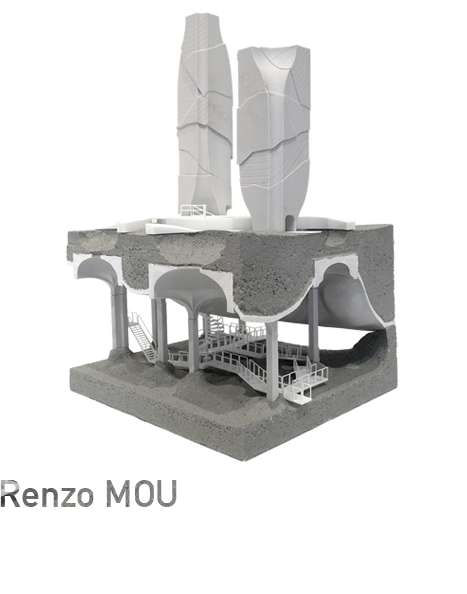
- Renzo MOU, “CRATERSCAPE: Territories of Conflict.”, Model Photo
- Renzo MOU, “CRATERSCAPE: Territories of Conflict.”, Model Photo
…In response, architects and designers might consider refreshing a traditionally binary view of the world that draws clear distinctions between the built and unbuilt environment and by extension, human and nonhuman forms of inhabitation, considering instead an exploration of design as an act of oscillation between such polarities.
Additionally, and given the fact that humans are increasingly capable of transforming the natural environment through the development of advanced technologies, we might argue that any approach to design should necessarily be considered within a broader context of geological time, that is to say, the future of the planet itself, in which any distinction between the natural and the man-made is by definition illusory.
Pointe du Hoc, located in Normandy, France, presents a unique condition of a human-altered landscape through the presence of bomb craters produced during World War II. At one point a stronghold of Nazi Germany, the site was heavily bombed by the Allied forces be¬fore their historic invasion to reclaim that part of France on D-Day. In subsequent years, the site has been further transformed through the gradual process of natural recovery, whereby various forms of plant and wildlife have re¬occupied this altered landscape of bomb craters. Hence, Pointe du Hoc might be seen as the result of interchanging human and non-human forces over time that has given rise to a post natural condition no longer reducible to either the natural or the manmade.
Based on this iterative history of inter¬changeable processes of destruction and reconstruction , this proposal attempts to explore the possibility of whether or not conventions of separation within the discipline of architecture that typically distinguish mass from void, interior from exterior, tectonic from topographic, subtraction from addition, and ultimately, architecture from landscape, might be reimagined as inherently ambiguous. By doing so, the act of architectural design enters the uncertain and unstable condition characterized by the site itself, that of material, formal, spatial, and programmatic montage, an ambiguous territory that can only be defined as in-between.
