









troy NEW YORK
Rensselaer Polytechnic Institute
Critic: William VIRGIL
suckerPUNCH: Describe your project.
Joseph SKULSKI: Technological advances are used to make our lives increasingly simple, although the creation of these advances and systems is extremely complex.
- Joseph SKULSKI, “Complex Simplicity.”, Perspective Render
- Joseph SKULSKI, “Complex Simplicity.”, Perspective Render
- Joseph SKULSKI, “Complex Simplicity.”, Perspective Render
- Joseph SKULSKI, “Complex Simplicity.”, Perspective Render
- Joseph SKULSKI, “Complex Simplicity.”, Perspective Render
- Joseph SKULSKI, “Complex Simplicity.”, Plan
Robotics paired with the integration of machine learning, and artificial intelligence is the perfect example of this. The amount of computational power required to complete a common pick and place procedure reflects an inherent relationship that technology has with simplicity and complexity.
Ornament too has a similar relationship to architecture, as the complexity of detail relates to the functional results of its application. Through digital methods and procedures an emergence of a new ornament has been made possible.
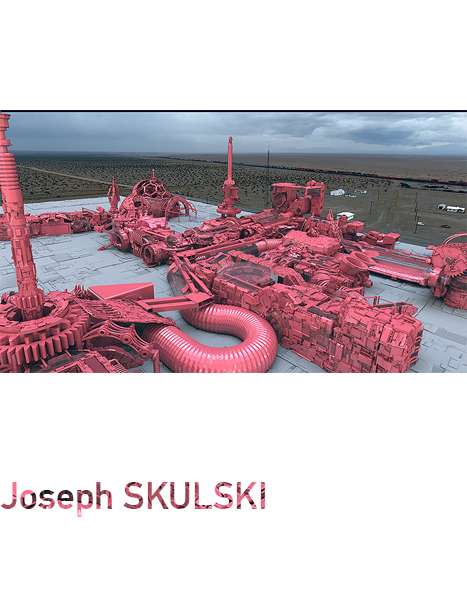
Along Route 66 in Amboy, California sits the deserted landmark of Roy’s Motel. Once built around a thriving mining town, attracting tourists and travelers from across the country, now lays dormant save a small dinner and gift shop. The opportunity to revitalize a deserted historic location such as this requires an attraction, a design of intrigue, and innovation.
Through the use of familiar technological components and a gradient of surface complexity, a relationship of architecture to digital ornamention is formed. Each programmatic location throughout the site preserves its own unique ornamental features while maintaining a unifying language.
The contemporary presentation style chosen represents the project thesis, integrating complex technological programing to achieve a visually simple result. A computer monitor attached to an ABB 2600 robot and two televisions were used as part of the performance, coordinating the three screens and robotic movements to showcase the intricacies and detail of the project.
In order to connect the robotic movements to the created animations, curves representing the camera paths were used to inform the robotic movements. Each animation informed an individual robotic movement procedure. Using an internal timer within the robot controller the robotic movements were accurately timed and recorded to create seamless timing and coordination of the presentation between the three screens.
