







los angeles CALIFORNIA
SCI-Arc
Critic: Herwig BAUMGARTNER
suckerPUNCH: Describe your project.
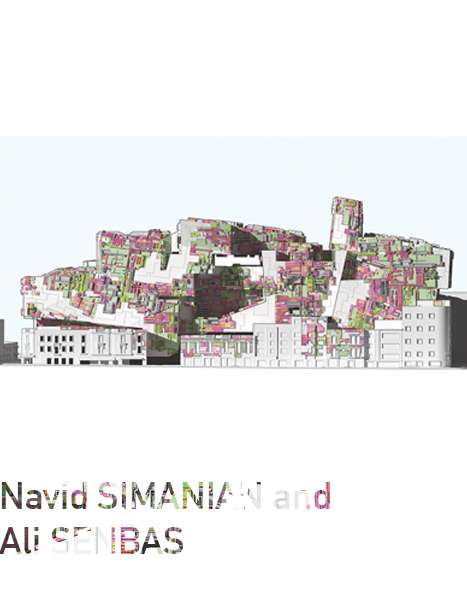
Navid SIMANIAN and Ali SENBAS: The project deals with the idea of contextualize in various architectural issues such as; ground and immediate context, organization and program, texture and material, massing, aperture and tectonics. The site in which the project is proposed is located in the historical downtown of Mexico City.
- Navid SIMANIAN and Ali SENBAS, “Super Contingent.”, Elevation
- Navid SIMANIAN and Ali SENBAS, “Super Contingent.”, Elevation
- Navid SIMANIAN and Ali SENBAS, “Super Contingent.”, Plan
- Navid SIMANIAN and Ali SENBAS, “Super Contingent.”, Plan
- Navid SIMANIAN and Ali SENBAS, “Super Contingent.”, Model
- Navid SIMANIAN and Ali SENBAS, “Super Contingent.”, Section Model
The site is a combination of multiple parking lots which are in poor condition. The site is a residual infill site that is a sort of leftover from the surrounding existing buildings within the block. The access from the street into the site is difficult. The expected architectural result is an infill project filling up the void that is left. The most striking issues concerning the site and the context are following; the difficulty of circulation and access, the architectural use of the irregular leftover void, the lack of open public area within the block and surrounding context, poor building and terrible aesthetic conditions (damages, cracks and untreated surfaces. etc.)
One of the central aims of the projects is to produce a project which is interdependent with its context. The building must not survive without the context. The building becomes completely valueless without it’s context. The project does not standout monumentally from the site but immerses itself with the site to produce a new whole. The autonomy of the project is sacrificed for the benefit of the context. In terms of mass, volume and scale project is essentially an aggregation of pre-existing masses and volumes collected from the surrounding blocks and reconfigured to produce a new massing under the new given conditions. Even though the project does not seem to be in scalar relationship with the macro and micro context as a whole, it ‘s partial volumetric scale is in consistent and constant relationship with the context. The massing should be understood as a meta-volume produced of partial volumes. The challenge which arises from this approach is a part to whole problem, how to make a whole from these parts.
The massing and the size of the project other than it’s spatial and aesthetic goals, is an act of densification. Introduction of a structure in such scale would have countless beneficial impact on Its local context such as; economic, infrastructural, aesthetic etc. Other than all of the given reasoning for the unusual scale of the meta-massing the scalar adaptation of the building is still a must. The scalar adaptation of the building to its context other than the partial scales of the volumes is also maintained by the sizes of the individual elements such as apertures, skylights, voids, exterior spaces, panelization, tectonic and patternization. There exist many wasted potentials within the site and the block such as the inactive roof-scape which is aimed to be transformed into, soccer fields (there are many other similar structures that can be show as precedents throughout the context.), the corners of the block (the most valuable plots) are not evaluated correctly mostly wasted on sheds and parkings. The project aims to change this issue.
Typologically speaking, the project is a hybridization of many different typologies that exists in the surrounding. The process of hybridization is an act of de-autonomizing the building. Single typologies bring autonomy and thrives to exists independently yet, hybrid typologies are against individualization. The building consists vertical elements, mat typology , bar typology and many other architectural types at the same time within a whole simultaneously. The building is partially lifted up to introduce a secluded open public space for the users and the context in general. This act of suspending the building partially and going above is a necessity arise from the lack of public space in the surrounding context. Also this strategy eases the circulatory problem and aims the access problem of the site. Pedestrian circulation within the block is prioritized by taking over the church corners and introduction of pathways. The ground environment, opposed to hostile parking, is now a human-friendly with the usage of greenery, soft-scape and user-friendly hardscape. The lighting problem that arises from the lifted problem is resolved by large scale skylights and voids that is placed strategically. The entry into the building from the ground level is granted mainly from the central circulation axis that runs longitudinally through the building, made easier with the use of escalators and elevators. The program of the project consists of a 70 retail space and 30 percent gym (natatorium being the main component.) The central void (corridor-like element) functions as the main circulatory element for the building. The placement of the gym and natatorium areas are governed criteria’s such as; natural lighting, and ventilation. (In our perspective the gym requires more environmental dependence than the retail space.) Retail space wants to seclude from exterior and the gym wants to be an exterior. The retail program in relation to the gym program is; PUBLIC, CONTINOUS & HOMOGENOUS. The gym program in relation to the retail is; PRIVATE, SEPERATED & HETEROGENOUS. The retail program mainly governed by the central linear circulation void inside the building. The gym is separated and divided into partial locations with a contextual strategy such as placement of fields on rooftops. Materially argumentation is based on pre-existing material use and existing precedent performances within the context. The primary skin materials are; 3D-PRINTED CUSTOM CERAMIC TILES (a heavily used material within the current and historical context. Other than contextual reasoning the environmental responses of these materials are great in terms of heat mitigation and retention, lighting, sound & acoustic improvements), metal claddings such as TITANIUM & ALUMINUM (The use of metal elements are great opportunities to introduce reflective surfaces for lighting issues and a strong cladding material which can improve the building’s structural performance.). The material application is based generally on few binary qualities such as; TRANSPARENT & OPAQUES, REFLECTIVE & ROUGH, THICK & THIN, STRUCTURAL & NON-STRUCTURAL, POUROUS & IMPERMEABLE. The structural system proposed for the building is the BRIDGE SUSPENSION SYSTEM. The reasoning for this system is minimalizing the amount of columns being used and allow the ground to be completely open for the public and users. One of the primary environmental elements in the building are the VERTICAL CHIMNEY & MULTI-STORY VOID elements. The SOLAR CHIMNEY, AIR-STACK EFFECT & EXHAUST systems gained from these architectural & spatial elements improves the environmental performance of our building in terms of lighting & air.
sP: What or who influenced this project?
NS & AS: My partner and I were influenced by three specific architects: Coop Himmelb(l)au, Thom Mayne, and Tom Wiscombe.
sP: What were you reading/listening to/watching while developing this project?
NS & AS: We started off with research on the Zeitz MOCAA, adaptive re-use building, by Thomas Heatherwick
sP: Whose work is currently on your radar?
NS & AS: The work by Oyler Wu Collaborative is on our radar for the near future
