









oakland CALIFORNIA
suckerPUNCH: Describe your project.
Clark THENHAUS: In the late 1960’s through the early 1980’s Victorian houses in the San Francisco Bay Area were, unlike today, cheap to rent and often occupied by progressive counter-culture young adults…
- Clark THENHAUS, “Then House #3.”, Perspective
- Clark THENHAUS, “Then House #3.”, Perspective
- Clark THENHAUS, “Then House #3.”, Plans
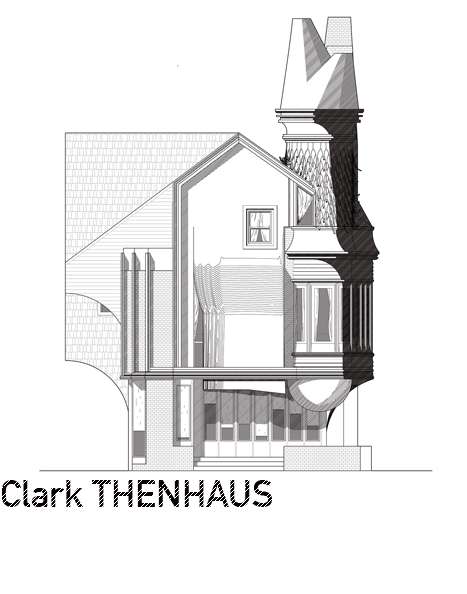
- Clark THENHAUS, “Then House #3.”, Elevation
In the late 1960’s through the early 1980’s Victorian houses in the San Francisco Bay Area were, unlike today, cheap to rent and often occupied by progressive counter-culture young adults. One might recall the exotic psychedelic theater group, The Cockettes, who communed in a Victorian house on Scott Street or Janis Joplin’s Victorian apartment on Ashbury Street just blocks away from the bright purple Victorian house where the Grateful Dead spent the Summer of Love (and where the famous drug bust of 1967 took place). In fact, many of the ‘endearing’ qualities that appeal to tourists of San Francisco today originate out of counter-culture expression from 40 or 50 years ago. Take as but one of many examples their exuberance of color. Historically, Victorian’s on the East Coast and Midwest were built using natural materials with natural colors like stone and brick. The Bay Area Victorian’s, however, took advantage of the Pacific Northwest timber industry, therefore building them cheaper and faster with lumber…and consequently opening the façade to alternative means of expression. During the 1960’s-1980’s the Victorian houses of San Francisco figured prominently in the Bay Area gay rights movement as occupants painted them in bright, multi-colored palettes as demonstrations of self-expression, calls for equality, and symbols of social transformation. Today, these houses are the cornerstones of San Francisco’s preservation polices – to the point that the Planning and Preservation code stipulates only 12 colors of paint that are acceptable. What were once domestic symbols of social transformation and cultural influence are now static representations of conservative planning and preservation policies. It begs the question, what exactly is being preserved by this restrictive code that stands in contrast to the history of the Victorian house as a source of social and architectural imagination? Perhaps it is more appropriate to preserve a culture of social transformation and architectural expressions then it is to constrain or solidify its aesthetic. To understand the code in this way leaves a few possible responses as an architect: Comply (uphold the stasis of preservation, to the point of trivialization), Ignore (to begrudge Victorian architecture as Kitsch and instead frame the Bay Area through the lens of “tech”) Re-stylize Modernism (see Dwell Magazine), or Double-Down. Then House No. 3 doubles down on the Planning and Preservation Code by exaggerating it, manipulating it, and perverting it into something that calls for an ‘almost familiar’ otherness at the margins of the codes intended limitations. It is both a critique of, and an exuberant embellishment on the San Francisco Planning and Preservation Code.
Furthermore, San Francisco Planning and Preservation Code stipulates rules on facade geometry, overhangs, projections, bulk, dimensions, setbacks and so on that have been adopted by neighboring municipalities. We wondered, could we create an ‘average plan’ that accommodates the nuances of limitations in the code, or at least one that averages the plan diagrams stipulating forms and dimensions for things like bay windows, turrets, dormers, and so forth that are found in the planning code? Then House No. 3 begins by cutting and pasting diagrams from the Planning and Preservation Code into an ‘average plan’. While the underlying plan is an average of the code regulations, the facades are geometrically exaggerated and materially manipulated expressions of local architectural endearments, such as a faux-fur lined dormer, a seemingly “inverted” bay window framed by protruding balconies (one in the roof, one from the wall), a shaggy-shingled corner turret, a front façade in the likeness of a hung sheet, a double witches cap and chimney top, and an absence of any code-approved color on half of the exterior walls. As was the case historically in the Bay Area, the single family house, and the Victorian’s in particular, elucidate relationships between broader culture, municipal codes, and architectural expression. With this as a cultural lens we might begin to also consider alternatives to housing in the Bay that contrast the current ubiquity of corporate development.
See more at: endemicarchitecture.com
