









ann arbor MICHIGAN
University of Michigan
Critic: Meredith Miller
suckerPUNCH: Describe your project.
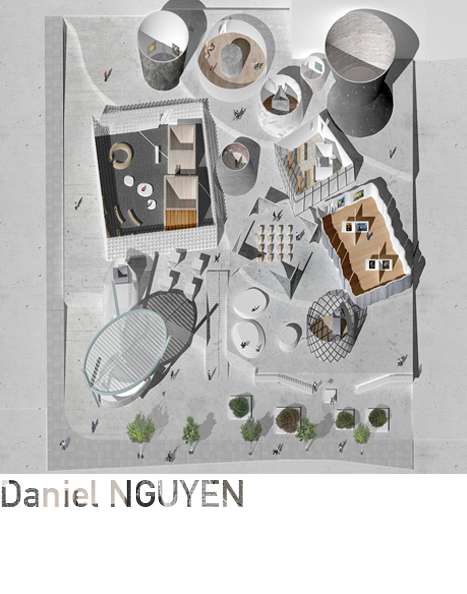
Daniel NGUYEN:The principles in composing a still-life speak to the relationships between objects, space, and content. As an image that flattens a collection of objects into a stationary moment, the still life captures the essence of a time, a place, and a culture…
- Daniel NGUYEN, “Still-Life Filter.”, Axon
- Daniel NGUYEN, “Still-Life Filter.”, Axon
- Daniel NGUYEN, “Still-Life Filter.”, Axon
- Daniel NGUYEN, “Still-Life Filter.”, Axon
- Daniel NGUYEN, “Still-Life Filter.”, Elevation
- Daniel NGUYEN, “Still-Life Filter.”, Roof Plan
- Daniel NGUYEN, “Still-Life Filter.”, Section
- Daniel NGUYEN, “Still-Life Filter.”, Site Plan
Many types of still-lives spoke to the status quo, artistic explorations, or composition studies, yet monotone still-lives emphasize the relationships between composed objects in space that can be translated spatially.
While the still life is a two-dimensional medium, this project translates certain principles of composition and collection as a design tool that can be applied at an architectural scale. This “still life filter” will be used to produce strategies of organization, form, and surface, to emphasize content and narrative in a mixed-use complex located in downtown LA. The site is an empty public park nearby Grand Central Market on which a still life building will operate. Because LA is filled with solid private art institutions, this program will be a more open public art institution suggestive of a library, studio spaces, and galleries; an institution with discreet parts that are collectively part of a whole. The goal of this design tool is to establish a technique and line of thinking that can influence the arrangement of discreet spaces in a cohesive manner in lieu of the 19th century exploration of still life images.
sP: What or who influenced this project?
DN: Roger Fenton’s still-life photographs began the conversation regarding the relationship between surfaces, shapes, and arrangement.
Also, of course, my thesis advisor, Meredith Miller.
sP: What were you reading/listening to/watching while developing this project?
DN: An atrocious amount of K-Pop, House M.D., and Medium articles about time management.
sP: Whose work is currently on your radar?
DN: WeWork and Noiz Architects. It’s always fascinating when companies disrupt the industry in ways that contest the status quo.
WeWork demonstrates that there are very real problems to be solved regarding user needs and very strategic solutions that are beyond academic fads and corporate banality. It feels like WeWork has started to change the game and their immense growth is evidence.
Noiz Architects is doing some cool work with one foot in the Japanese architecture scene and one foot in the Japanese tech scene. They are in a unique position that allows them to be agile designers, researchers, and programmers who are in a field of their own.
