







los angeles CALIFORNIA
SCI-Arc
Critic: Andrew ZAGO
suckerPUNCH: Describe your project.
James JIANG: This project focuses on the reconstruction and re-connection between the building, the State of Illinois Building, also known as the James R. Thompson Center, to the city Chicago…
-
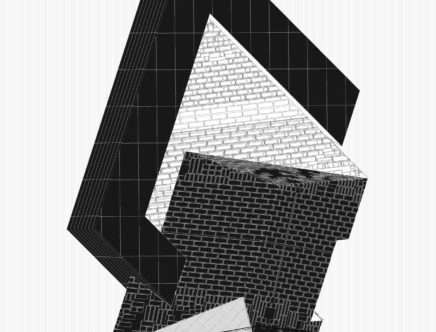
- James JIANG, “Big Dumb Building.”, Elevation
-
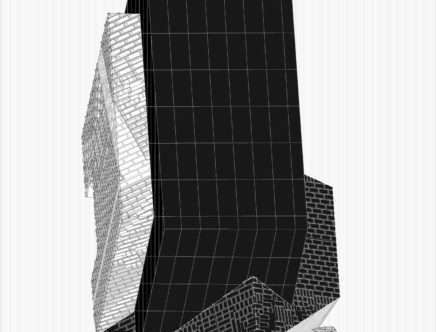
- James JIANG, “Big Dumb Building.”, Elevation
-
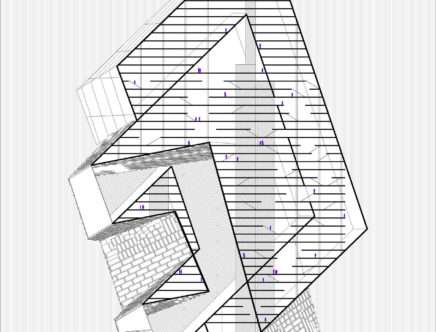
- James JIANG, “Big Dumb Building.”, Section
-
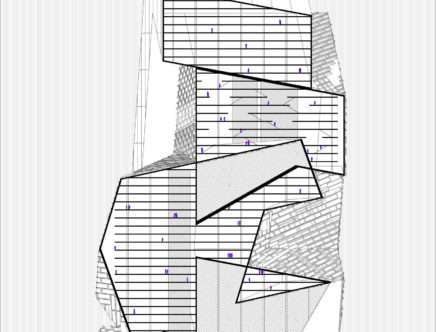
- James JIANG, “Big Dumb Building.”, Section
-
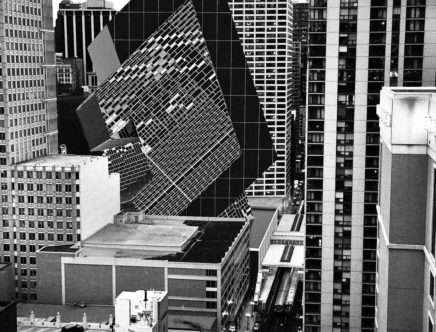
- James JIANG, “Big Dumb Building.”, Perspective
-
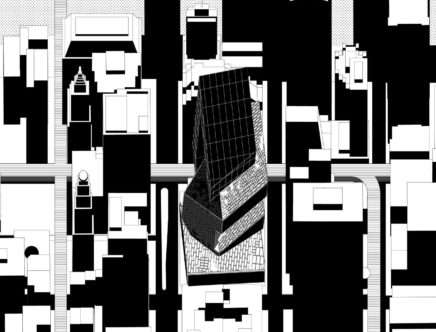
- James JIANG, “Big Dumb Building.”, Perspective
…Furthermore, this concept aims to establish this architecture as the center of the city, through the process of connecting the building and the city. To establish the building as a part of the city, and the city as a part of the building, would therefore be able to create such linkage.
Through the analysis of Chicago’s city plan, we could summarize the following on the concept of Chicago’s city center - In 1909, when Burnham suggested the Chicago’s city plan, the center of the city was on the Michigan Avenue. Soon after the construction of the Loop, the city center has shifted within the boundary of the loop, and after the formation of the four government building, the city center has again shrank to be bounded by these buildings. As a result we could conclude that the idea of city center is constantly shifting. It has no clear boundary but defined by streets, buildings, and trains. Therefore, a city center could be a street, an area, a block, or a building.
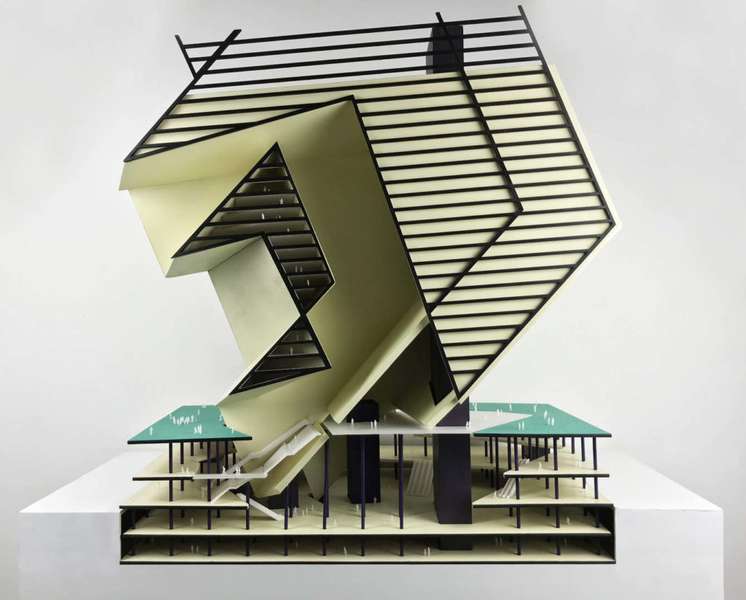
The project began with a series of study on the precedent buildings in the world. Through a detailed study of the program, circulation, and organization, the precedent buildings were then transformed. In this example, Piazza Farnese, a courtyard building, is being transformed by skewing, then flipping inside-out. The original atrium of the Farnese is then broken, and reconstructed into a new atrium, connecting to the ground. The interior volume is also flipped onto the outside, and forming a new, habitable program. Lastly, this transformed massing is placed onto a plinth, covering the bottom part of the atrium and the ground, and becoming a transition space between the inside and the outside.
The program distribution of the building separates the four main programs into different space. The hotel, occupies the top of the building, is connected by the elevators straight from the ground floor and the roof lobby. The government office, takes over a large section of the middle part of the building, overlooks into the atrium and sits across the commercial office. The commercial office is located in the lower - middle
floors, also being separated by the atrium from the government offices. Lastly, the retail is located in the
bottom floors, the plinth, all the way to the underground of the building, connecting with the pedway and the metro station.
The facade uses a brick pattern for the exterior, as well as using a basic grid mullions for the “guts” of the building. Double layers of the brick pattern is applied to the interior face of the original Farnese when it was flipped out, and a single layer of brick pattern is used on the exterior face of the original Farnese. One end of the plinth is hypothetically extended and also flipped, yet the flipped part of the plinth is turned into a brick pattern mesh, enclosing the entrance space of the building, as well as the roof garden. The atrium space, as a formal tool, strengthens the concept of city connecting to the building, by physically and spatially connects the interior of the building with the exterior. This process took three steps: 1. placing the building into the ground to formulate the physical connection between the atrium and the ground. 2. To have the first floor and second floor connecting to the atrium. 3. To have the atrium connecting to the roof garden. With these three steps, the circulation of urban life flows from the outside of the building, to the roof garden, and to the atrium.
The public space is located in the underground floors, ground floors, second, and third floors. The underground floor connects the pedway and the metro station, allowing people to travel freely underneath the main building.
The roof garden is the last floor that has a public space for the three programs. It is connected by a big steps reaching up from the ground floor and second floor. The interior of the building in the roof garden level also functions as a semi-public lobby for the government office, commercial office, and the hotel, separated from the retail shops. From the each side of the building, inhabitants are able to walk out onto the roof garden, onto public spaces on the outside.
The upper floors, consist of the offices and the hotel, has a constantly rotating program on each level. On the 10th floor, a typical floor level where commercial and government offices co-exist, are separated by the atrium in the middle. Window Mullions follow the logic of the inside-outside flipping of the building, which is perceivable by the inhabitants of the building. The hotel lobby is located on the 37th floor, equipped with restaurant, conference hall, and gym.


August 11th, 2018 at 12:04 pm
Come on man, this is so intellectually lazy.