








chicago ILLINOIS
Penn Design
Critic: Kutan AYATA
suckerPUNCH: Describe your project.
Alexander BAHR: With the rise of fake news, alternative facts and confirmation bias, being a daily peril of contemporary life, this project explored and researched if there existed a danger between fact and belief within architecture, and if so how can it be either exploited or embraced.
-
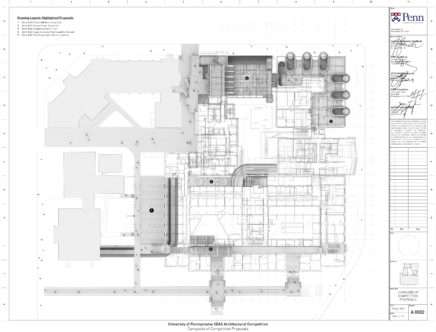
- Alexander BAHR, “Play of Parts: The Whole is not Always Greater than its Sum.”, Site Plan
-
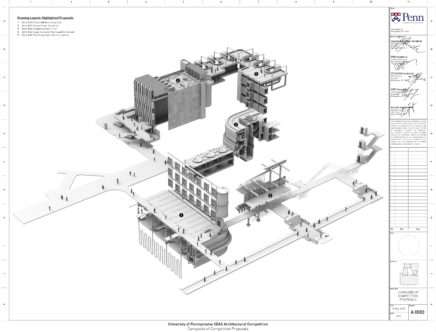
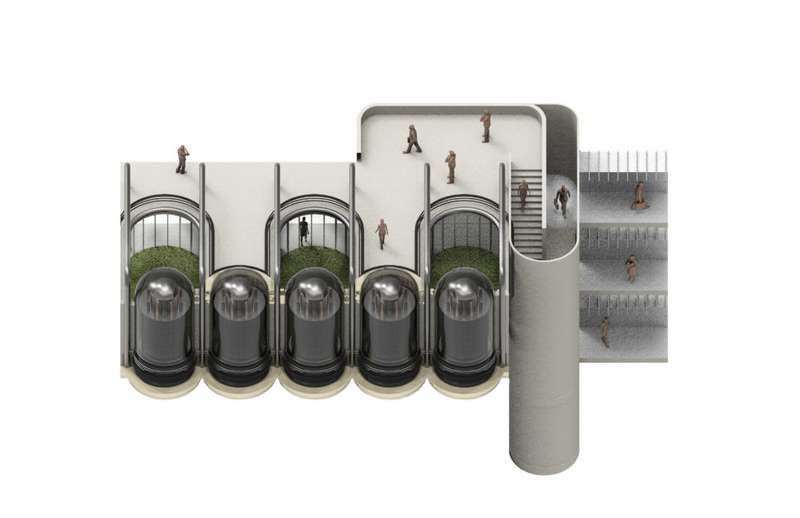
- Alexander BAHR, “Play of Parts: The Whole is not Always Greater than its Sum.”, Axon
-

- Alexander BAHR, “Play of Parts: The Whole is not Always Greater than its Sum.”, Perspective
-
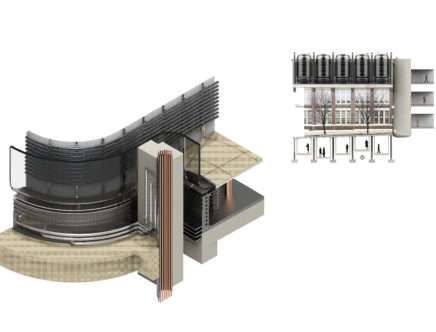
- Alexander BAHR, “Play of Parts: The Whole is not Always Greater than its Sum.”, Axon
Carlo Ginzburg and Adriano Prosperi’s Games of Patience describes the perils that laid before this path of research and describes the method of a game in which this project chose to use as its method of testing and playing through many different ideas and schemes.
This game took the form of a traditional architectural competition, with defined rules, and was played in order to place the audience in a position of critical contemplation and, as Robert Venturi wrote, ‘make its spaces and its elements become readable and workable in several ways at once.’ By making the difference between what is real and fake indistinguishable, the project was able to “play” with the audiences’ sensations and completely transform elements that were once believed to be unimportant, banal and mundane.
Much like how art theorist Viktor Shklovsky wrote about “The Knight’s Move”, this project attempts to combat this notion of false reality, fake news, from the side to point the audience towards this contradiction at its center. Methods of estrangement, representations between collage and montage, a creation and presentation of a para-fictional world are just materials in which arm the audience against the power of aesthetics. Thus this project learned that the central problem of this research is not if you can find an architectural methodology that could create an architectural “whole”, certainly many different techniques and approaches do so, but instead if that methodology is capable of critically looking back at itself and constantly putting into crisis its concepts of what is ‘real’.
“There comes a moment (though not always) in research when all the pieces begin to fall into place, as in a jig-saw puzzle. But unlike the jig-saw puzzle, where all the pieces are near at hand and only one figure can be assembled (and thus the correctness of each move be determined immediately), in research only some of the pieces are available, and theoretically more than one figure can be made from them. In fact, there is always the risk of using, more or less consciously the pieces of the jig-saw puzzle as blocks in a construction game. For this reason, the fact that everything falls into place is an ambiguous sign: either one is completely right or completely wrong. When wrong, we mistake for objective verification the selection and solicitation (more or less deliberate) of the evidence, which is forced to confirm the presuppositions (more or less explicit) of the research itself. The dog things it is biting the bone and instead biting its own tail.”
-Carlo Ginzburg and Adriano Prosperi
See more at: http://alexander-bahr.squarespace.com
sP: What were you reading/listening to/watching while developing this project?:
AB: This project started by focusing and expanding upon two books that laid the foundation for different arguments of parts and their relationship to the whole within architecture. Those books were Complexity and Contradiction in Architecture by Robert Venturi and OMA’s Elements, a part of the 2014 Venice architecture biennale. Other books that were very influencial to this work were The Sphere and the Labyrinth by Manfredo Tafuri and the writings from Timothy Morton and Viktor Shklovsky.
sP: What or who influenced this project?
AB: A very special thanks needs to go to my mentor and thesis advisor Kutan Ayata, who stuck with me from the very beginning and dedicated his time and energy into seeing this work be the very best it could be. I couldn’t imagine working on this with a better person.
