







college station TEXAS
University of Texas A&M
Critic: Nathan HUME and Gabriel ESQUIVEL
suckerPUNCH: Describe your project.
Luis Fernando MUNOZ, Stephanie MADDAMMA, Sephorah BELIZOR, and Brazos PINTO: This project is an exploration of graphics and their interpretations and possibilities.
- Luis Fernando MUNOZ, Stephanie MADDAMMA, Sephorah BELIZOR, and Brazos PINTO, “The Billboard.”, Interior Render
- Luis Fernando MUNOZ, Stephanie MADDAMMA, Sephorah BELIZOR, and Brazos PINTO, “The Billboard.”, Perspective
- Luis Fernando MUNOZ, Stephanie MADDAMMA, Sephorah BELIZOR, and Brazos PINTO, “The Billboard.”, Model Photo
-
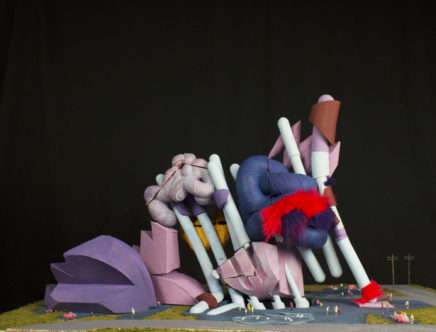
- Luis Fernando MUNOZ, Stephanie MADDAMMA, Sephorah BELIZOR, and Brazos PINTO, “The Billboard.”, Model Photo
- Luis Fernando MUNOZ, Stephanie MADDAMMA, Sephorah BELIZOR, and Brazos PINTO, “The Billboard.”, Unrolled Elevation
-
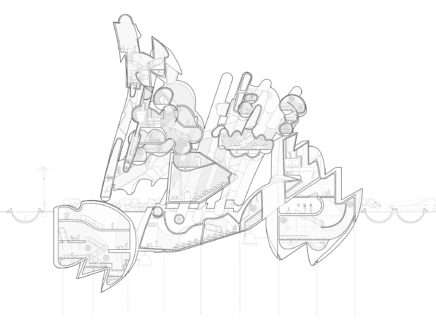
- Luis Fernando MUNOZ, Stephanie MADDAMMA, Sephorah BELIZOR, and Brazos PINTO, “The Billboard.”, Section
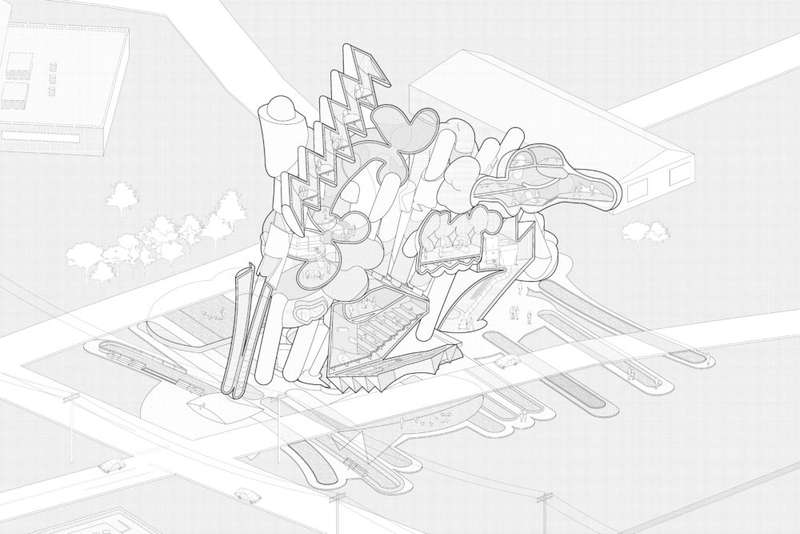
We define “the graphic” as two-dimensional figures that overlay or project over objects. The graphic is no longer a representational vehicle, but is now used as a means to unroll an object and connect or disband parts, constantly oscillating between being fixed and becoming. We take the notion of the architectural billboard and unroll it, using the graphics as a way to exploit the spatial latency that lies within them.
The billboard has historically acted in many different ways but mainly as 2-dimensional imagery used to promote specific values of any given subject. It is as well a cultural icon that yields attention, yet denies interaction. However, in this project, the billboard becomes an architectural object that develops into habitable graphic space through giving volumetric qualities to 2-dimensional figures. The binding of dissimilar yet congruent figures though the application of the graphic projections, that at times unroll over the surfaces and generate phenomenal objects, and at other moments transpose though dimensions to flatten spaces. We move away from an application of a super-graphic , and materials no longer only slip from floor to wall to ceiling but they also cross boundaries and thresholds beyond dimensions to create their own graphic space that trespasses and unrolls the building, the objects, and spaces. This unrolling, as opposed to an unfolding poses an object that is always in the state of trying to know itself, in a point of self reflectivity.
Acting as objects themselves, the graphics exist within the building in a three dimensional
state, allowing other objects to inhabit them. These objects which are inhabiting graphic space are unaware of the qualities of the graphics themselves, causing the building to never be fully knowable at any point in time..Through the use of graphic as an object we question the subject and destabilize their relationships. Objects inhabiting graphic space are unaware of their placement within, however the graphic as an object is aware of its placement and of that which inhabit it.
