









oxford ENGLAND
Oxford Brookes University
Critic: Barry WARK, Maria KNUTSSON-HALL and Andreas KÖRNER
suckerPUNCH: Describe your project.
James GREGAN: The project pictured is for the Oxford Botanical Gardens. Its mission statement is ‘To promote the furtherance of learning and to glorify nature. The garden aims to educate about the importance of plants, the conservation of plants and to support teaching and research of plants anywhere.
- James GREGAN, “Oxford Botanical Gardens.”, Plan
- James GREGAN, “Oxford Botanical Gardens.”, Section
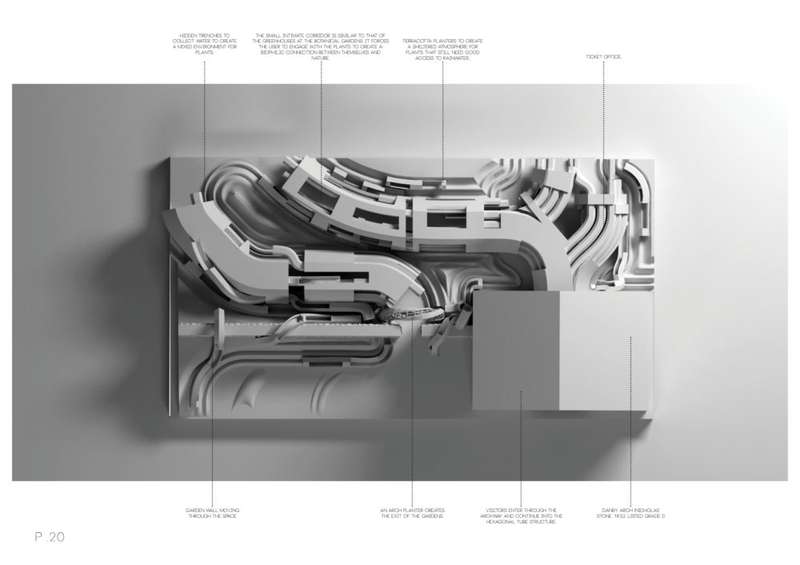
- James GREGAN, “Oxford Botanical Gardens.”, Model
- James GREGAN, “Oxford Botanical Gardens.”, Model
I began my project looking for geometric shapes in nature to form complex surfaces and to create biophilic areas. During my research, I found that a Beehive is made up of Hexagons as it uses the least amount of material to hold the most weight. This means it saves the bee energy and material which makes the shape extremely efficient. In my initial tests,
I tried to recreate the characteristics of a Beehive by cutting out-holes and removing pillars and found
these created impressive spatial characteristics, similar to that of Iranian architecture such as the Bazaar of Kashan.
During a site visit to the gardens, I found the layout of the corridors meant visitors are forced to interact with a series of complex massings of extravagant plants, due to the tight, narrow spaces. Walking through the greenhouse gardens you felt you were immersed in a botanical world despite being near the heart of Oxford. I wanted to capture this feeling and use it for the entrance of the site, as the current ticket office did not fairly represent the emotion and feeling of being in the gardens itself. I believed the two areas felt
very disconnected.
My design therefore, is an attempt to reference the existing architecture on the site, whilst adding my own research on geometric shapes in nature. I created a series of intimate corridors out of hexagonal extrusions and cut into them, much like the Zeitz MOCAA Museum by Thomas Heatherwick. This hopefully forces visitors to engage and form a biophilic connection with the space whilst creating a variety of lighting conditions due to the range of species of plant.
