









ann arbor MICHIGAN
Univesity of Michigan
Critic: Jeff HALSTEAD
suckerPUNCH: Describe your project.
David ALCALA: Utilizing insight’s gained by studying Stanley Kubrick’s films and his usage of distilled
perspectives, a method was found with which to develop space.
- David ALCALA, “Hotel.”, Elevation
- David ALCALA, “Hotel.”, Elevation
- David ALCALA, “Hotel.”, Elevation
- David ALCALA, “Hotel.”, Elevation
Utilizing insight’s gained by studying Stanley Kubrick’s films and his usage of distilled
perspectives, a method was found with which to develop space. Whereas, Charlie Kaufman’s
Synecdoche, New York and Michel Foucault’s Of Other Spaces: Utopias and Heterotopias led
to developing a conceptual framework to move forward alongside these initial studies on
distilled perspectives.
Synecdoche New York follows Caden Cotard and the production of his ‘Masterpiece’ in which
he attempts to replicate the mundanity of daily life in New York City on a 1:1 scale inside of a
warehouse. As his manufactured reality within the warehouse continues to grow and become
more life-like, Caden’s life begins to veer off course, and the lines between Caden’s reality and
his manufactured reality are increasingly blurred.
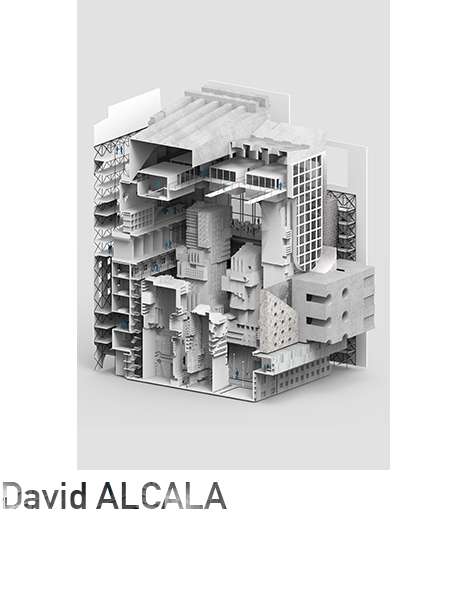
The hotel plays a game of scale, exploring scalar relationships on multiple levels and throughout
different building elements of the project. How can a city within a city begin to blur the
boundaries between interior and exterior thresholds? How can traditional views on subjectivity
and perception be altered and misconstrued within the built environment?. A series of
frameworks were developed to work on answering parts of these questions. The first framework
appears as the billboards, taking moments from within the interior of the hotel and projecting
them onto the billboard. This creates an obfuscated and skewed reality of what exists within the
project as the user transitions from exterior to interior. Through this transition, the user is given
a first glimpse of what to expect within the interior of the building, and yet once inside, the user
finds an alternate version of this reality. The billboard is not a true representation, but rather a
manufactured and distilled perspective of the activity that happens within. This framework is
advanced when one realizes that the billboard can become inhabitable space. Certain spaces of
the billboard are real, while others are virtual.
As these building elements culminate into a cohesive whole, the architecture seeks not only to
be a hotel but utilize this game of Scale, Perception, Subjectivity, and Obfuscation to bring into
question what the potential of what a hotel may really be. Existing as a place outside of that
which is considered “the ordinary”, the hotel aims for a feeling of temporality rather than
permanence. All the while utilizing cinema and perspective variations as a vehicle with which to
develop formal, conceptual and organizational methods of design.
sP: What or who influenced this project?
DA: The project was influenced by Jeff Halstead, Stanley Kubrick, Charlie Kaufman, and Le Fresnoy
by Bernard Tschumi.
sP: What were you reading, listening to or watching while developing this project?
DA: Watching: Charlie Kaufman’s Synecdoche New York , Wes Anderson’s The Life Aquatic and Isle
of Dogs and an assortment of Stanley Kubrick films.
Listening/Watching: various Tyler, The Creator music videos, Flatbush Zombies, Kendrick
Lamar
Reading: Michel Foucault’s “Of Other Spaces: Utopias and Heterotopias”
sP: Whose work is currently on your radar?
DA: Architects: Frank Gehry, SO+IL, fr-ee, Eric Owen Moss, Atelier Manferdini, T+E+A+M
Artists: Dan Flavin, Michael Heizer, James Turrell, Donald Judd, Walter De Maria
