








ann arbor MICHIGAN
Univesity of Michigan
Critic: Jeff HALSTEAD
suckerPUNCH: Describe your project.
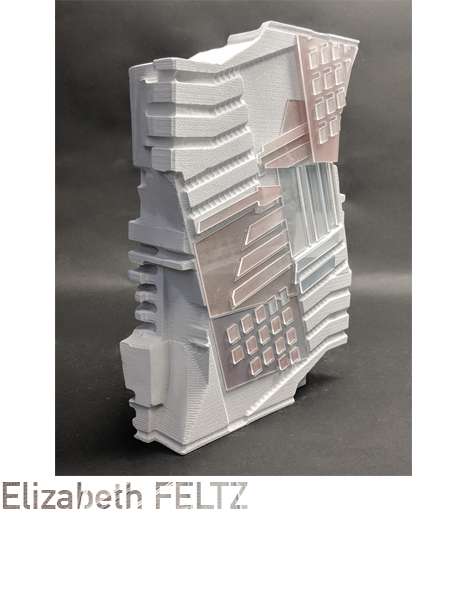
Elizabeth FELTZ: This project investigates the ways in which perspectival variation in film can influence how architects portray design narratives. The hotel, serving as a host for a variety of encounters, assists in showcasing the duality of private affairs and choreographed entertainment.
- Elizabeth FELTZ, “SoSCOPIC.”, Elevation
- Elizabeth FELTZ, “SoSCOPIC.”, Elevation
- Elizabeth FELTZ, “SoSCOPIC.”, Model Photo
- Elizabeth FELTZ, “SoSCOPIC.”, Model Photo
In Walter Benjamin’s The Work of Art in the Age of Mechanical Reproduction he discusses the differences between painter and cameraman, comparing them to a magician and a surgeon. The magician views a scene from a distance, making implications and provoking mystery while the surgeon slices the scene into pieces, moving carefully around the scene to represent what the audience desires like an act of manipulation. Through the act of projecting pre-existing facades onto a new form, we take the role of the painter/magician viewing from a distance. The ability to cut the form and expose certain moments can put us into the role of the cameraman, allowing us to choreograph our desired narrative. The moments in which the form is sliced can be an opportunity for performance or a look into what the users of the hotel are doing. These cuts are a way to dissect the hotel and expose certain aspects of the hotel that are not always marketed to the consumer. Since film has portrayed hotels as sites for crime, sex, horror, etc, these slices can turn private events into unscripted performances.
The massing has a slice through the center which creates two opposing sides, as if the building has a “split personality.” In the cut through the massing, there is an opportunity to alter what the user sees staring back at them through a series of lenses. Through certain modes of representation, we are able to make the same people and places look completely different. For example, Christian Bale’s character in American Psycho is viewed in two different ways even though his character is internally unchanging. One version of the character is a perfectionist in every sense, representing himself in a way that makes the audience uneasy due to his rehearsed sociopathic interactions. The murderous side of him is more unhinged, to point where his scenes of violence are disturbing yet equally relieving because we are seeing him in his true mental state and the social tension no longer exists. The merge of violence and humor is purely based on his representation by the director. This counterintuitive duality also exists in movies like Inglourious Basterds or Fargo when a personality, scene, or topic is unchanging but its representation alters our emotional reactions.
sP: What or who influenced this project?
EF: The studio began the project by studying various directors, artists, and architects. I became interested in the ways that Quentin Tarantino produced a juxtaposition between humor and violence, allowing the viewer to become more self-critical of their emotions. I wanted to learn more about how this perception was created with camera angles and varying perspectives and how this unique representation could be applied to the built environment.
sP: What were you reading, listening to or watching while developing this project?
EF: Readings: Scopic Regimes of Modernity - Martin Jay, Everything Is Already An Image - John May, The Work of Art in the Age of Mechanical Reproduction - Walter Benjamin, In Defense of the Poor Image - Hito Steyerl
Film: Inglourious Basterds - Quentin Tarantino, Adaptation - Spike Jonze, Fargo - The Coen Brothers, The Shining - Stanley Kubrick, American Psycho - Mary Harron
sP: Whose work is currently on your radar?
EF: MILLIØNS, Alisa Andrasek, Mark Foster Gage, Jakob + MacFarlane
