









kent OHIO
Kent State University
Critic: Jean JAMINET
suckerPUNCH: Describe your project.
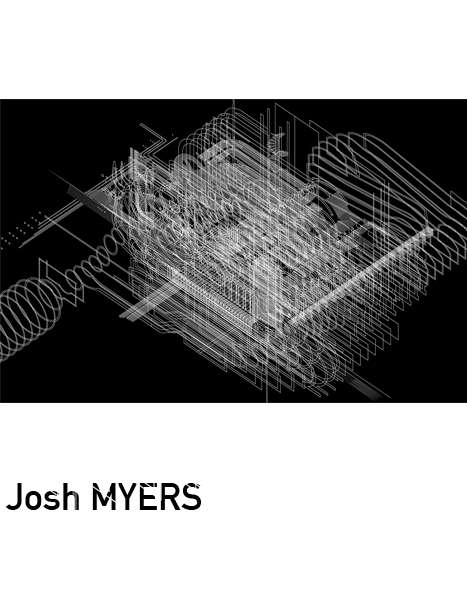
Josh MYERS: The synthesome (synthesis+rhizome) is defined by the synthesis of infrastructural elements that compose it and the rhizomatic quality that it has; elements within the synthesome do not simply operate independently.
- Josh MYERS, “Synthesome.”, Section
- Josh MYERS, “Synthesome.”, Axon
- Josh MYERS, “Synthesome.”, Elevation
- Josh MYERS, “Synthesome.”, Axon Section
Infrastructure works as a system that spawns from multiple sources and weaves between elements of our built environment, sometimes operating with it and other times disrupting it across the span of the entire city. Often, infrastructure is not questioned until it fails. A water line is not noticed until it starts leaking, a street lamp is not questioned until it begins flickering. It is through the subliminal nature that the synthesome emerges as another reality, one that magnifies current infrastructural systems but also recontextualizes them to change the way that they define the city. The synthesome (synthesis+rhizome) is defined by the synthesis of infrastructural elements that compose it and the rhizomatic quality that it has; elements within the synthesome do not simply operate independently. They overlap, intersect, and turn in on themselves, resulting in a variety of densities across the domain. The synthesome thus becomes an alternate version of Brazilia from the movie Brazil where the system relies not on culture or context but operates as its own object. It is only influenced or challenged by architecturally implemented elements that fit into its reality.
The architectural implications of the synthesome are represented through the culmination of a building object and a ground object that become part of the synthesome but also create a microcosmic density within it. The building object’s form is developed from the qualities of corrugated drain pipe. Thus, the corrugated articulation offers the building structure and form, creating a poche that creates the false semblance of density. The massing and interior organization are disrupted by impeding volumes that contain the corrugated articulation at a different scale. This is represented with vast apertures on the exterior that form volumetric channels on the interior. Much like the way Warhol distorts the qualities of the subject with his polaroids in drag by allowing his own facial features to be seen along with the makeup and wig, the building object represents and misrepresents the drain pipe and its features architecturally by allowing tension to exist between the drain pipe and the invented building object.
The ground object, on the other hand, directly operates within the synthesome by creating a disruption within it. The ground object is composed of pipes and volumes that turn in on themselves in a way that creates the massing and interior organization. The way pipes invade other spaces results in consumptive and regurgitative spaces; one volume consumes another, producing another volume as a resultant. This challenges the bidirectionality of infrastructural elements, which is further articulated through the implementation of the grate object. This secondary object replaces surfaces on the ground object and creates detail within volumes. Thus, this new object is not simply a parasitic element of the ground object but, instead, is able to operate as its own object. The ground object both relies upon and invades the synthesome around it. It is mainly a rhizomatic density but also must reach out to attach itself to the adjacent sewer lines in order to be a part of the reality.
The synthesome expresses tension between the principles that typically define architecture. Infrastructural pipes must both support themselves and effectively channel substances; therefore, pipes are expressed as both line and form simultaneously. Thus, the synthesome exists in both of these forms as well, constantly seeking to create form out of line while simultaneously seeking to simplify form into line. The synthesome is just one of many ways that architecture is able to augment cultural narratives to produce a reality that allows us to question our relationship to our own reality.
sP: What or who influenced this project?
JM: Ferda Kolatan’s Real Fiction’s Cairo studio, Andy Warhol’s self-portraits in drag, Paul Rudolph’s Cannon Chapel, and Brazil
sP: What were you reading/listening to/watching while developing this project?
JM: Brazil, Bob’s Burgers, Son Lux, Miles Davis, Thee Oh Sees, “Machines are Digging” by Reza Negarestani, “Cyborg Urbanization” by Matthew Gandy
sP: Whose work is currently on your radar?
JM: SU11, Rojkind Arquitectos, and Zago Architecture
