








berkeley CALIFORNIA
University of California, Berkeley CED
Critic: Neyran TURAN
suckerPUNCH: Describe your project.
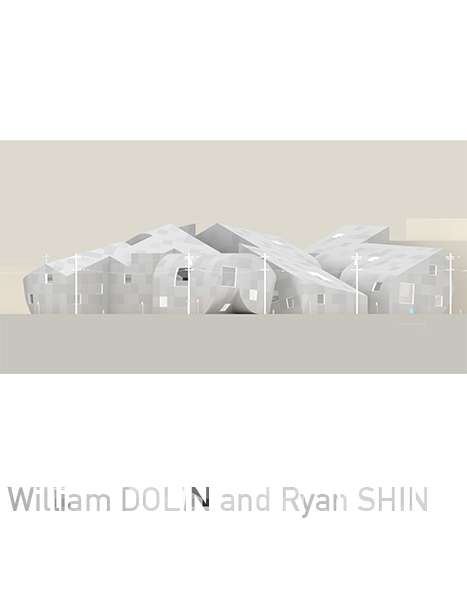
William DOLIN and Ryan SHIN: A housing project that exists within a grey zone between traditional models of ownership and co-operative living, this building attempts to challenge contemporary notions of productivity and efficiency.
- William DOLIN and Ryan SHIN, “Alone Together.”, Elevation
- William DOLIN and Ryan SHIN, “Alone Together.”, Section
- William DOLIN and Ryan SHIN, “Alone Together.”, Plan
- William DOLIN and Ryan SHIN, “Alone Together.”, Sectional Axon
This project begins with an initial interest in group form project typologies, buildings that read as assemblies, and investigates the inevitable part to whole relationships that emerge within these formal compositions. Through the manipulation of rectangular volumes on a cartesian grid by way of conic sections, the project’s form begins to distort itself; it clearly reads as an aggregate, yet the edges of the objects are blurred. It becomes a building of many parts and many wholes.
This same conceptual interest (the part to whole misreading) is carried through to the interior (the life) of the project by way of programmatic strategies which aim to foster similar qualities of the exterior— not by means of offsetting but by investigating how potential misunderstandings in the way things are constructed can be architecturally productive. Traditional apartment buildings distribute program uniformly, with each unit containing all essential rooms for the residents. Residents are completely isolated from one another, spare the brief interactions in spaces of circulation. They also only occupy a small portion of the entire building’s footprint. Co-operative housing suggests some level of shared space, meaning residents cohabitate some predefined program. Interaction is encouraged, and notions of ownership are blurred. Our project rejects these two models as we take the programmatic diagram of the single family home, and scale it instead of arraying it. Program distribution occurs at the scale of the building, not the unit, taking advantage of the group form typology to provide a formal separation between internal activities. For example, one volume contains all the kitchens in the building, while another contains all the living rooms. This produces an idiosyncratic floor plan, which adapts to both form and program.
With this scaling of the house diagram, our project’s entire third level becomes an attic, representing a vertical divide between storage and living in the building. The attic space is open ended, in stark contrast to the first two levels, prompting residents to define the space of storage themselves.
Through these two independent narratives, the formal construction of the exterior and the internal arrangement of program, this project attempts to use a singular concept and interest as a tool that can generate design in distinctly different ways. The result is an earnest proposal for an alternative home.
sP: What or who Influenced this project?
WD and RS: Architecture in Extremis (Sylvia Lavin), Investigations in Collective Form (Fumihiko Maki) and others.
sP: What were you reading/listening to/ watching while developing this project?
WD and RS: Watching Maniac (Cary Joji Fukunaga) reading On Beauty (Zadie Smith) listening to American Dream (LCD Soundsystem)
sP: Whose work is currently on your radar?
WD and RS: Office KGDVS, WOJR, Go Hasegawa, NEMESTUDIO
