










cambridge MASSACHUSETTS
Harvard GSD
Critic: Jennifer BONNER
suckerPUNCH: Describe your project.
Andy BAKO: The etymology of the word “normal” means “that which is made by the carpenter’s square.” It is manufactured by humans, consists of right angles, and behaves predictably…
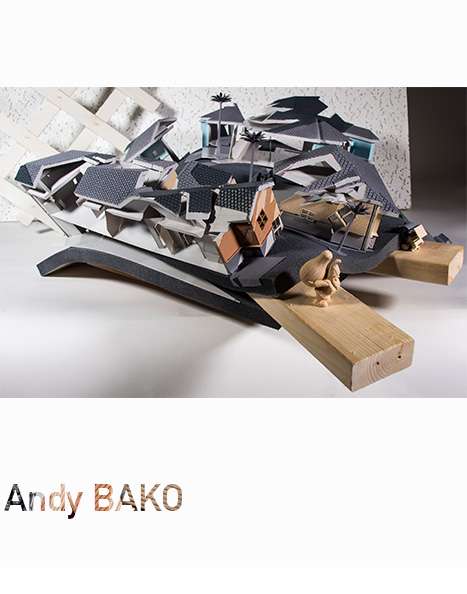
- Andy BAKO, “Normal House.”, Model Photo
- Andy BAKO, “Normal House.”, Section
- Andy BAKO, “Normal House.”, Plan
- Andy BAKO, “Normal House.”, Perspective Drawing
- Andy BAKO, “Normal House.”, Model Photo
- Andy BAKO, “Normal House.”, Model Photo
In the postwar decades, the convergence of mass media, shortage of housing and the federal need to reconstitute the “social body” made normality no longer something innate, but rather a quality to be actively pursued. Despite its exclusionary history, unsustainable patterns of growth, and intrinsic economic volatility, the image of the “normal house” is still one that resonates with the current housing market.
A defining characteristic of suburban architecture is the economic model that revolves around consumer choice, and the illusion of individuality via property. This system, like the architecture itself, is actively designed. This systematized effort is conducted to make home ownership, family life and even your choice of normal house incredibly easy. Through the coordination of normality and automaticity we continue to produce an architecture of the status quo. Today, this regularity is incongruous with the diverse set of domestic arrangements of the people that now occupy the suburbs, which is over half the country, coming from a very diverse set of backgrounds, and not just the “nuclear family” anymore.
In response, the project of the ‘normal house’ is seen as a point of departure in the working out of a stance that explores the tensions between architectural form and its representation. Counter to a convenient stillness, a contemporary posture of “Lazy Deconstructivism” leans toward inconvenient motion made easy – utilizing the tension between an object’s physicality and simulation to become a new working method. This stance relishes in the predictable representational banality of BIM and in the ease of the consumer App as sites for an architecture of simulative interrogation. How can a plastic architecture of unpredictability allow for the more accommodating “model home”?
