








ann arbor MICHIGAN
University of Michigan
Critic: Craig BORUM
suckerPUNCH: Describe your project.
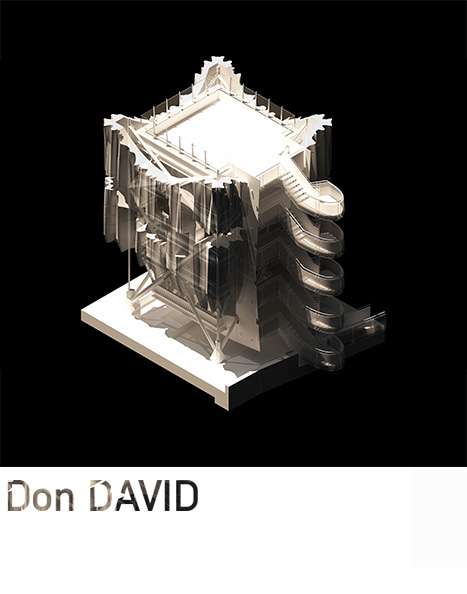
Don DAVID: From the classical Greek column standards, to geometric patterns of traditional Islamic Mosques, to the exposed structural systems of Centre Pompidou, there is a simple understanding that is shared across cultures and time…
- Don DAVID, ” Identity-Literacy: The Role of Tectonics in Place-Making.”, Perspective
- Don DAVID, ” Identity-Literacy: The Role of Tectonics in Place-Making.”, Perspective
- Don DAVID, ” Identity-Literacy: The Role of Tectonics in Place-Making.”, Model Photo
- Don DAVID, ” Identity-Literacy: The Role of Tectonics in Place-Making.”, Model Photo
– architectural ‘information’ and tectonics shape the way we receive buildings and articulate the built environment – allowing architecture to become a generative, cultural vessel.
The project has two parallel tracks of interest. One being grounded in a formal focus of component-thinking and tectonic language as a means of generating structural and formal logic. The second landing within the territory of Frampton’s ‘Critical-Regionalism’, which brings cultural context into the purview of tectonic language, as a means of making salient and literate the attributes of a given locale.
This response to culture – or the translation and production of it – through tectonic language, can span across time. Architecture can mimic a commonly used façade material or construction detail in a specific region, but can also recall historical narratives or actively subvert or omit them. Whatever the design intention, there is a foregrounded assertion that architectural language is the primary tool for sculpting cultural identity, place-making, and is the most efficient way to make architecture that is literate to the ‘non-designer.’ Suddenly the ‘column’ and the ‘roof’ become paragraphs, with their own internal syntax, and vocabulary. In a way the project seeks to not just ask questions about what words to invent, but also their grammatical structures as well as what narratives they articulate – a lens without any defaults, where everything is a question of morphology.
The site of the project is the lesser-known Arrephorion, which is a small structure on the ancient Greek Acropolis, in Athens. This location is where the project moves away from the general terms of Critical-Regionalism, as this unique site makes the building inevitably stuck out of time – rewriting and tracing historical narratives, through contemporary tectonic means. For instance, here, we are not interested in how the residential ‘Mediterranean-shutter’ re-articulates itself in a contemporary architecture. Here, we are interested in the narratives that surround the Arrephorion and the other Acropolis structures – the peplos and fabric-weaving; stereotomy; structural autonomy; polychromy; cloistering and transparency.
Ultimately, the work is interested in tectonics and the diagram of architectural language as impetus for creating articulate and particular constructs. And, to make a particular ‘place’, architecture must present particular grammar, and suggest particular narratives – all with an awareness of the physical languages that surround and precede it.
