







los angeles CALIFORNIA
SCI-Arc
Critic: Tom WISCOMBE
suckerPUNCH: Describe your project.
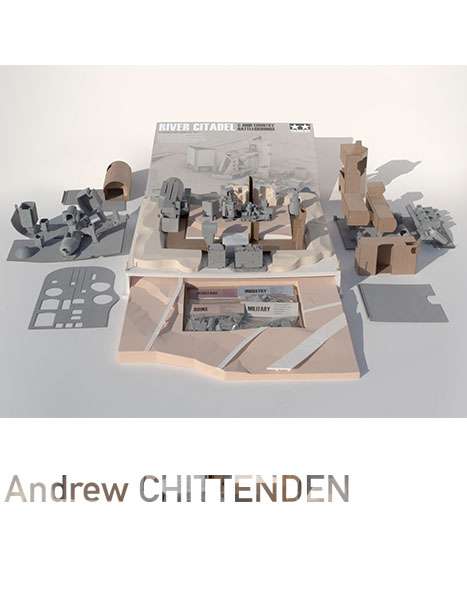
Andrew CHITTENDEN: Model kits offer the opportunity to question the traditional role of scale models in architecture.
- Andrew CHITTENDEN, “River Citadel & Ohio Country Battlegrounds.”, Exploded Axon
- Andrew CHITTENDEN, “River Citadel & Ohio Country Battlegrounds.”, Envelope Diagram
- Andrew CHITTENDEN, “River Citadel & Ohio Country Battlegrounds.”, Model Photo
- Andrew CHITTENDEN, “River Citadel & Ohio Country Battlegrounds.”, Model Photo
- Andrew CHITTENDEN, “River Citadel & Ohio Country Battlegrounds.”, Model Photo
- Andrew CHITTENDEN, “River Citadel & Ohio Country Battlegrounds.”, Model Photo
The model need no longer solely represent another, larger object, but may also contain its own inner life and its own systems. The box itself becomes a constraint, forcing the parts of the building to nest, stack and merge into new relationships, and sit alongside standard model kit accessories like cutaway drawings, assembly diagrams, decals, and figures.
The River Citadel reimagines Elphinstone Tower, a 16th century Scottish tower keep, as a model kit. Just as these stone monolithic structures persisted through the centuries through multiple tenants, uses, and physical transformations, so the model kit accumulated layers and layers of new forms and variations, each stacking like sediments upon the last, sagging under or pressing up against the weight of the developments resting on them. That accumulated history then spills out onto a new site outside Columbus, OH, to produce a high security, fortress-like campus for the pharmaceutical research company, Covermymeds, which finds itself beseiged by hostile forces both past and present.
Using battleground models as a template, the model kit emphasizes the site and grounds surrounding the citadel, which can be assembled at two different scales for both strategic and close up battles. Included in the kit are small “entourage” sets of figures, including military equipment, industrial machinery, cultural flags and decals, and historic ruins and artifacts.
sP: What or who influenced this project?
AC:John Soane’s geological, archaeological and archival approach to history and architecture, seen most prominently in the Bank of England and the Soane Museum, broadened the scope of what could be accomplished with a model kit.
The paintings of Robert Adam helped question architecture’s relationship to its landscape and context.
OMA’s adaptive reuse work (built and unbuilt), primarily Fondazione Prada and the Hermitage Museum.
Tschumi’s Le Fresnoy
sP: What were you reading/listening to/watching while developing this project?
SC: Gilbert Simondon, “The Genesis of the Individual” (from Zone, 1992)
Alfred North Whitehead, “Science and the Modern World”
Massimo Scolari, “Oblique Drawing”
Jennifer Gabrys, “Program Earth”
Tom Sachs sculptures
Andrej Tarkovsky’s Stalker (1979)
Karsten Harries, “Building and the Terror of Time” (from Perspecta, Vol. 19, 1982)
August Schmarsow, “The Essence of Architectural Creation” (1893, from Empathy, Form and Space, 1993)
Holly Herndon
sP: Whose work is currently on your radar?
AC:T+E+A+M, First Office, Herzog & de Meuron, Neutelings Riedijk Architects, Valerio Olgiati, Andrew Kovacs, Carme Pinos, Liam Young, Casey Rehm
