


Ads
Ads

Ads

Ads

Ads

Ads

Ads

Ads


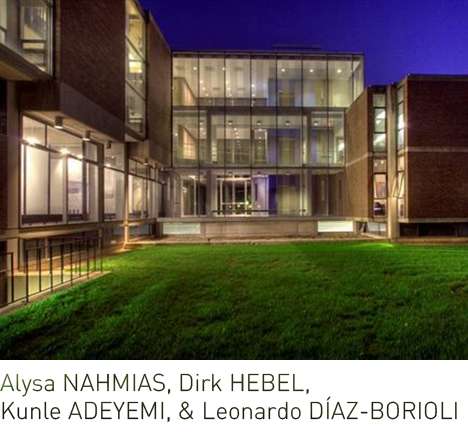
New Brave Worlds
princeton NEW JERSERY

Princeton SOA Lecture Series: “What I Did Next: Princeton’s Alternative Architectural Practices”

[LIVE STREAM]

“
New Brave Worlds (Africa/Latin America),” with Alysa NAHMIAS, 
Dirk HEBEL, 
Kunle ADEYEMI, 
& Leonardo DÍAZ-BORIOLI
Wednesday, 04/03
6.00pm / Betts Auditorium
Princeton SOA
Princeton, New Jersey 08544

Peter EISENMAN
troy NEW YORK

Peter Eisenman is an American architect, writer and educator whose work has long been informed by reading architecture through a wide range of cultural, intellectual and philosophical references. Famous during the late 1960s for his pioneering houses from his days among the New York Five, he has since then remained at the forefront of architectural discourse through the buildings he has produced, the numerous books he has written, and the lectures and courses he has taught.

Peter EISENMAN
, “A Defense of Architecture”
Wednesday, 04/03
6.00 pm / EMPAC Theater
Rensselaer Polytechnic Institute
110 8th Street
Troy, New York 12180

Fractal Projections
los angeles CALIFORNIA

suckerPUNCH: Describe your project.

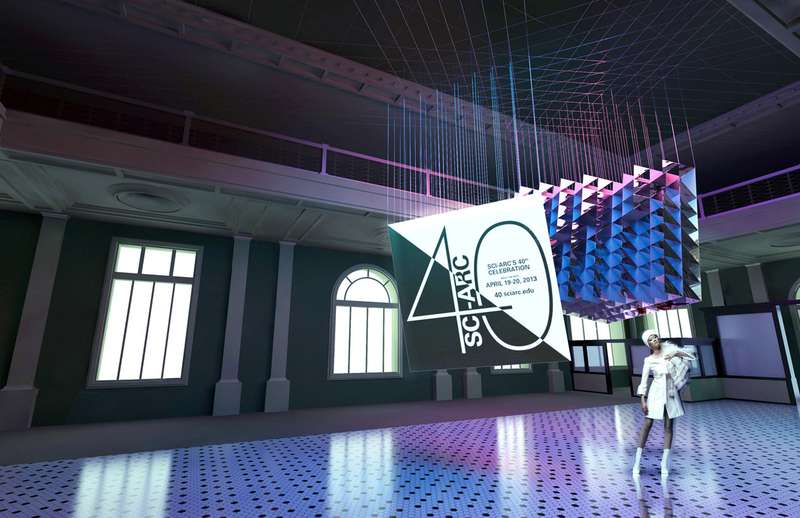
Eugene KOSGORON & Evelina SAUSINA: Fractal Projections is a play on the idea of the cube broken in space to create an interlocking grid system that follows a linear deformation, allowing them to break from the norm grid behavior into a family of fractal surfaces. Audience is meant to circulate the space to discover the projections that is composed from a series of smaller cubes that houses these fractal surfaces. Fractal Projections pays homage to architecture and how SCI-Arc Alumni have transformed the school over the 40 years.

[MORE]

Ingeborg ROCKER
los angeles CALIFORNIA

Ingeborg M. Rocker was appointed Associate Professor of Architecture at Harvard in 2011, after serving as assistant professor there since 2005. Rocker’s theoretical work is devoted to questions regarding the impact of media on the perception, production, and thinking of architecture. As a designer and teacher of design, she deploys computer modeling as a tool for giving form to theoretical hypotheses in a didactic way. Rocker’s ongoing research has been widely publicized through numerous international magazines and books.

Ingeborg ROCKER, “Recursion: Aesthetics + Logics of Computation”
intro. by Marcelo SPINA
Wednesday, 04/03
7.00 pm / W.M. Keck Lecture Hall
SCI-Arc
960 East 3rd Street
Los Angeles, California 90013


new haven CONNECTICUT

Wang Shu, 2012 Pritzker Prize laureate, founded Amateur Architecture Studio in 1997 with his wife, Lu Wenyu, in Hangzhou, China. Wang & Amateur Architecture Studio are known for built works including: Library of Wenzheng College, Suzhou University, China (2000); Ningbo Contemporary Art Museum, Ningbo, China, (2005); Five Scattered Houses, Ningbo, China (2005); Vertical Courtyard Apartments, Hangzhou, China (2007); and more.

WANG Shu, “Construction in Amateur Architecture”
Paul Rudolph Lecture
Wednesday, 04/03
6.30 pm / Hastings Hall
Paul Rudolph Hall
Yale School of Architecture
180 York Street
New Haven, Connecticut 06511

MoCA: Surface-to-Volume
los angeles CALIFORNIA

CONCEPT ///
This project is a sixteen foot high inhabitable pavilion which will be exhibited in The New Sculpturalism show at the MoCA Geffen Contemporary in Los Angeles, opening June 1, 2013. It was chosen in an invited competition held by the Museum last summer, and now the heat is on to realize it.

The project is a study of surface-to-volume transformations, where mass is achieved by pushing into a surface like a fist through a rubber sheet. In this case, chunky objects are pushed into exterior skins, creating volumetric effects on the interior. The perimeter edges of the three components of the piece are razor-thin, creating visual tension between the realms of 2-D/flat and 3-D/massive.

[SUPPORT]

[MORE]

Contemporary Vernacular
los angeles CALIFORNIA

Southern California Institute of Architecture (SCI-Arc)
advisor: Hernan DIAZ ALONSO

suckerPUNCH: Describe your project.

Jason ORBE-SMITH: This thesis examines elements of vernacular architecture as a means to influence and generate contemporary form.

As society moves towards a state of interconnectivity, heterogeneity and the globalization of politics, culture and economy, this thesis reinvestigates the discussion concerning the native, indigenous and local with notions of the cosmopolitan, global and foreign.

[MORE]

Michael YOUNG, Depth and the Optical Vector. Photo: Jacob Comerci.
columbus OHIO

The “Possible Mediums” Conference, which took place at The Ohio State University Knowlton School of Architecture from February 07-10, 2013, brought together 18 designers, 120 students (from the four co-host schools: The Ohio State University Knowlton School of Architecture, University of Illinois at Chicago School of Architecture, University of Michigan Taubman College of Architecture + Urban Planning and University of Kentucky College of Design), and special guests John McMorrough and Jeffrey Kipnis, to participate in design workshops and formal discussions surrounding the question of mediums in contemporary architecture.

[MORE]

Photo: copyright 1980, Ave Pildas.
los angeles CALIFORNIA

The first to open in the Pacific Standard Time Presents: Modern Architecture in L.A. series, an initiative of the Getty, this SCI-Arc-hosted exhibition examines the pivotal role played by the temporary gallery held in the home of architect Thom Mayne for several weeks in 1979.

“Modern Architecture in L.A.: A Confederacy of Heretics: The Architecture Gallery, Venice, 1979”
Friday, 03/29 / Opening Reception w/ curators and SCI-Arc Director Eric OWEN MOSS
7.00 pm / SCI-Arc Gallery & SCI-Arc Library Gallery
SCI-Arc
960 East 3rd Street
Los Angeles, California 90013

Curators: Todd GANNON, Ewan BRANDA, & Andrew ZAGO
Exhibition design: Zago Architecture

[MORE]

Joseph DANIELS & Eric CHEN, Affective Machines.
troy NEW YORK

Rensselaer Polytechnic Institute (RPI)
critic: Casey REHM.

Students explored the image making ability of complex systems through a series of exercises targeted at analyzing and leveraging behaviors expressed through color and mechanical precedents. Students analyzed physical relationships in early industrial automatons and machines to produce logics for the organization of material in a multi-agent systems. Students then explored color relationships in Dutch still life painting, which they then integrated into their mechanical systems as new behaviors.

[MORE]