



Ads
Ads

Ads

Ads

Ads

Ads

Ads

Ads


  • Assembly One Pavilion
    new haven CONNECTICUT

    Assembly One Pavilion
    Designed and built by: Yale School of Architecture students

    The Yale ‘Assembly One’ pavilion is the younger, smaller, more carefree sister to Yale’s building project - the 40-year old tradition in which first-year students design and build a house.

    [MORE]

  • Haze
    copenhagen DENMARK

    suckerPUNCH: Describe your project.

    MAST (ivar HEGGHEIM, jon ANDERSEN, rasmus MØLLER, & mads m. ANDERSEN): It is a playful way to exterior and interior. the exterior is textured with an array of panels with flaps and apertures the interior is a soft and furry dome structure. The Installation is structured around two main toruses & three minor toruses that create the arches. The cross section cuts of the main toruses create the voids (entrance). Light permeates through the crevices of each element. The hair is both responding to underlying formal features, & underlining the character of the pavilion seen from a distance and enhancing the way the visitors engage with the soft interior.

    [MORE]

  • Materia Vulgaris — Common Ground
    bucharest ROMANIA

    suckerPUNCH: Describe your project.

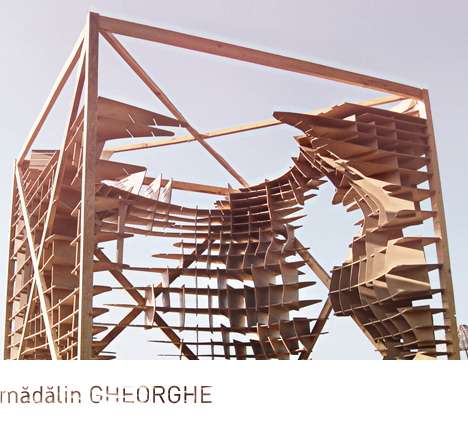
    andrei RADUCANU, madalin GHEORGHE, & andrei IVANESCU: Materia Vulgaris — Common Ground (competition entry for the 2012 Venice Biennale Romanian Pavilion)

    The phrase “common ground” appears in the language of architecture (and not only there) usually in connection to virtual territories, places where ideas or cultural phenomena converge. Lately, the architectural speech particularly tends towards this interpretation, sometimes excluding the materiality of the equation.

    [MORE]


  • los angeles CALIFORNIA

    suckerPUNCH: Describe your project.

    gabriel a. HUERTA: The Page Park Pavilion is a proposed multifunctional pavilion sited in George C. Page Park between the LACMA campus and the Page Museum at the La Brea Tar Pits. The design intent was to create a pavilion that would explore the shaping of space with materials and light and yet be both programmatically flexible and formally responsive to its context.

    [MORE]

  • Snail Pavilion
    los angeles CALIFORNIA

    suckerPUNCH: Describe your project.

    LADG: Snail Pavilion is a competition entry for the Ceramic Tiles of Italy trade show pavilion. The purpose of the pavilion is for the trade association to represent its member companies’ products at a series of shows over a three-year term. Instead of selecting just a few sample products to feature, the scheme uses hundreds of tiles from Ceramic Tiles of Italy member companies to create giant snails that bristle with the range and depth of Italian ceramic products. In this way the pavilion is more like a library with tiles stacked on shelves than it is a surface against which tiles are set in a rigid grout bed. Visitors can literally occupy the entire history and product catalog of the member companies, arrayed as plumage that alternately bristles or lays flat in cowlick whorls.

    [MORE]

  • Dragon Skin Pavilion
    hong kong CHINA

    suckerPUNCH: Describe your project.

    kristof CROLLA (LEAD), sebastien DELAGRANGE (LEAD), emmi KESKISARJA (EDGE), and pekka TYNKKYNEN (EDGE): The Dragon Skin Pavilion is an architectural installation designed and built for the 2011-12 Hong Kong & Shenzhen Bi-City Biennale of Urbanism\Architecture.

    The Pavilion utilises a newly developed environmentally friendly material called “post-formable” plywood, which incorporates layers of adhesive film to allow easy single-curved bending without the need for steam or extreme heat. With no material loss, a CNC mill divided 21 of these 8×4 plywood sheets into eight identical squares, and accurately cut the unique connection slots that were programmed into the pavilion geometry by computer.

    [MORE]

  • Coney Inland
    cambridge MASSACHUSETTS

    Cameron Wu (Cambridge, MA) proposed Coney Inland, an architectural strategy which formally unifies and spatially modulates the challenging MoMA PS1 courtyard site. A series of developable surfaces (cones and cylinders) and their base structures normalize the contingencies of scale and shape of the three courtyard spaces, while their legible transformations register the idiosyncratic nature of the overall site geometry.

    [MORE]

  • Mechanical Garden
    cambridge MASSACHUSETTS

    Ibañez Kim Studio (Mariana Ibañez and Simon Kim) proposes a Mechanical Garden that enjoyed a unique partnership with artists and engineers in Philadelphia.

    The Mechanical Garden is a social stage for PS1 activities as well as for architecture-as-characters. A strong figural demarcation assembles a series of Characters into generously shaded arcades and walkways. This peripheral organization reinforces the existing geometries of the courtyard walls, but thickens them with canopy and programme - to allow for indeterminacy and found situations. Each Character is constructed from similar elements in fixed modules, but have differentiation in traits and features. They vary in orientation, internal spaces and function.

    [MORE]

  • Wendy
    new york NEW YORK

    HWKN’s “Wendy” wins MoMA PS1’s 2012 Young Architects Program (YAP).

    From the designers: Wendy does not play the typical architecture game of ecological apology - instead she is pro-active. . That is why Wendy is composed of nylon fabric treated with a ground breaking titania nanoparticle spray to neutralize airborne pollutants. During the summer of 2012 Wendy will clean the air to an equivalent of taking 260 cars off the road. Wendy’s boundary is defined by tools like shade, wind, rain, music, and visual identity to reach past the confines of physical limits. Wendy crafts an environment - not just a space. Spikey arms reach out with micro-programs like blasts of cool air, music, water canons and mists to create social zones throughout the courtyard.

    Any thoughts? See more HERE.

    [MORE]

  • M-Box
    silivri TURKEY

    This project was built as part of the student event MEDS, Meeting of European Design Students, during a two week period in August 2011. The theme was to design a pavilion that relates to the connection between Europe and Asia.

    The interior of the Blue Mosque represents the starting point for the concept. The ellipse of light is the geometry that inspired the project. In order to determine the interior space of the pavilion, an ellipse is used to generate a fluid organic shape which eventually has to adapt to the constraints of the diagonals of the box.

    [MORE]