


Ads
Ads

Ads

Ads

Ads

Ads

Ads

Ads

Ads

Ads

Ads


  • Stan ALLEN & Marc McQUADE, eds., Landform Building: Architecture's New Terrain.
    2011

    Green roofs, artificial mountains and geological forms; buildings you walk on or over; networks of ramps and warped surfaces; buildings that carve into the ground or landscapes lifted high into the air: all these are commonplace in architecture today. New technologies, new design techniques and a demand for enhanced environmental performance have provoked a re-thinking of architecture’s traditional relationship to the ground. The book Landform Building sets out to examine the many manifestations of landscape and ecology in contemporary architectural practice. . . .

  • Greg LYNN & Mark Foster GAGE, eds., Composites, Surfaces, and Software: High Performance Architecture.
    2011

    How computer technologies and digital fabrication techniques give architects unprecedented tools for crafting performance and aesthetics through cross-disciplinary collaboration. . . . Boat, airplane, and automobile design tools and software are now applied to architectural projects using robotics and high-strength, low-weight, carbon fiber composites. Greg Lynn’s studio and Mark Foster Gage’s seminar at Yale with participants Frank Gehry, Lise Ann Couture, Chris Bangle, and Greg Foley, among others generated a lively dialogue invigorating the future of design.

  • Sylvia LAVIN, Kissing Architecture.
    2011

    Kissing Architecture explores the mutual attraction between architecture and other forms of contemporary art. In this fresh, insightful, and beautifully illustrated book, renowned architectural critic and scholar Sylvia Lavin develops the concept of “kissing” to describe the growing intimacy between architecture and new types of art—particularly multimedia installations that take place in and on the surfaces of buildings—and to capture the sensual charge that is being designed and built into architectural surfaces and interior spaces today.

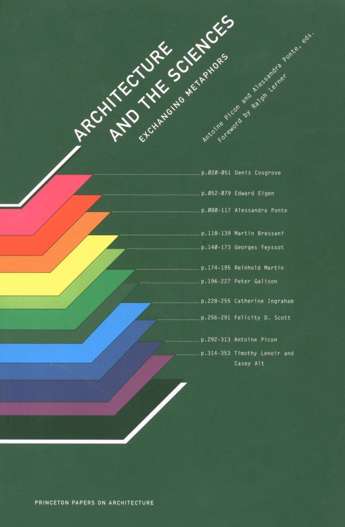
  • Alessandra PONTE & Antoine PICON, eds., Architecture and the Sciences.
    2011–12

    Since antiquity, the sciences have served as a source of images and metaphors for architecture and have had a direct influence on the shaping of built space. In recent years, architects have been looking again at science as a source of inspiration in the production of their designs and constructions. Architecture and the Sciences shows how scientific paradigms have migrated to architecture through the appropriation of organic and mechanical models. Conversely, architecture has provided images for scientific and technological discourse. Accordingly, this volume investigates the status of the exchanges between the two domains.

  • Marcelo SPINA and Georgina HULJICH, Patterns Embedded.
    2011

    Marcelo Spina and Georgina Huljich are principals of the office PATTERNS founded in Los Angeles in 1999. The research and collaborative based approach of the practice seeks to move between digital and material expressions. PATTERNS describes its form-making as Driven by digital techniques and advanced computation. . . .

  • log

    log
    2003-ongoing

    cambridge university press: the only full treatise on architecture and its related arts to survive from classical antiquity, the architecture libri decem (ten books on architecture) is the single most important work of architectural history in the western world, having shaped architecture and the image of the architect from the renaissance to the present.

  • HENSEL, MENGES, & HIGHT, eds., Space Reader.
    2009

    The “Space Reader” provides a highly pertinent and contemporary understanding of space for a new generation of students and architects. It espouses a definition of space that is heterogeneous (an object or system consisting of a diverse range of different items). . . . With the onset of globalisation and the Web, heterogeneneous space, with its emphasis on differentiation, is more relevant to the contemporary condition, which encourages the mixing of space, than a much more static conception of Modernist space.

  • el croquis
    ongoing

    el croquis is a beautiful large format publication with each issue dedicated to an architect. one of the best sources for detailed documentation of contemporary projects. each issue filled with crisp line drawings and vivid photographs of built work and working models. recent issues include sanaa, herzog + demeuron, zaha hadid.

  • Greg LYNN & Mark RAPPOLT, eds., Greg Lynn Form.
    2008

    One of the most provocative and exciting architects today, Greg Lynn has defined how designers and architects use computers as a medium, operating in an expanded field that fuses cutting-edge technology, contemporary art, and science fiction aesthetics with architectural form. At the epicenter of a debate about the role of digital design in architecture and design, his projects skillfully blend high technology and detailed craftsmanship, driven by modeling software from the film and aerospace industries. Included are contributions from theorists, architects, and artists, and futurists such as J. G. Ballard and Bruce Sterling.

  • taschen basic architecture series
    2003-ongoing

    each book focuses on one architect and includes drawings, sketches, photographs as well as brief biography, project descriptions, introductory essays, and project map. These affordable books are compact samplers of some of the twentieth century’s greatest architetcs. Volumes of notice include albert frey, marcel breur, antonio gaudi, walter gropius, adolf loos, richard neutra, jean prouve, and r.m. schindler.