



Ads
Ads

Ads


Ads

Ads

Ads

Ads

Ads

Ads

Ads


  • Bi-Polar
    college station TEXAS

    Team:Matt MILLER, Dale FENTON, Emau VEGA, Aubrie DAMRON, Adrian CORTEZ
    Photos: Emau VEGA

    Texas A&M University FabLab, Gabriel ESQUIVEL: The project began as a performative wall system that reacted differently to exterior and interior spaces. We realized we had to confront the fact we had two different surface logics, so rather than trying to blend these conditions, we decided to emphasize the difference indicating two current design directions. This resulted in two polar opposite geometries with opposite personalities that strongly defined exteriority and interiority. Bi-Polar can then be explained more effectively in three systems working together: (1) The tessellated parametric logic performative exterior, (2) the loose free-flowing sensual interior, and (3) the in-between performative bladder system that mediates between the two extremes.
    [MORE]

  • visual permeability pavilion
    new york NEW YORK

    suckerPUNCH: describe your project.

    fast PACE, slow SPACE: The purpose of this pavilion is to provide multiple spaces for relaxation, contemplation, and social interaction. The two spaces within the project are broken apart, providing one space for two people to relax in a more private setting, and one space for four people to have a conversation or drink. The angling of the wooden slats was designed to maximize this separation for the private zone, and minimize it for the public zone; thus creating a gradient of visual permeability.

    [MORE]

  • performative ornament
    brooklyn NEW YORK

    suckerPUNCH: describe your project.

    evan TRIBUS+ezra ARDOLINO: Historically, the most critical element in the delivery system of ornamental effects was applied molding. From the Greeks and Romans to the Renaissance, Gothic and Baroque through the Victorian period, exterior and interior moldings served to provoke visual interest through the play of light and shadow across its articulated surfaces. Moreover, molding was underwritten by the relationship between the precision of its inherent geometry (a cross-section extruded along an axis) and its effectual geometries (the surfaces that receive light and project shadow).

    [MORE]

  • glowb
    lexington KENTUCKY

    suckerPUNCH: describe your project.

    laurel CHRISTENSEN: Glowb is a self-contained night light made of a single, laser cut sheet of heavy duty blue poster board painted silver on the outside. The Glowb emits a light blue glow when turned on in a dark room, while the cut-out shapes project playful patterns of light on surrounding surfaces, creating a fun and dynamic night time environment. Glowbs can be grouped to intensify this effect.

    [MORE]

  • POLYP.lux
    new york NEW YORK

    Flash:Light: 2011
    Festival of Ideas for the New City

    SOFTlab produced a hanging installation for the entrance to School Nite, an exhibition of site-specific installations, performances, and discussions. The installation was curated by Nuit Blanche New York as part of Flash:Light 2011 along with the Festival of Ideas for the New City sponsored by the New Museum. 

The installation was in the entrance of St. Patrick’s Catholic School at the corner of Prince and Mott Streets in NYC.

    [MORE]

  • skin
    paris FRANCE

    suckerPUNCH: describe your project.

    jorge AYALA: Skin is an organic self-structure, an artificial corpus overlapping meshing systems and subsystems, inhabiting space and challenging its perception. Skin was conceived as a computational design, based on emerging logics of construction and manufacturing. Large Scale CNC along with high tech matters and other techniques will be employed to rapid prototype and assemble this processual design.

    [MORE]

  • theBench
    southfield MICHIGAN

    suckerPUNCH: describe your project.

    benjamin BERR+natalie HADDAD+brent DEKRYGER:
    The Initial design approach was to find an architectural solution utilizing multiple methods of digital fabrication to create a performative product.

    [MORE]

  • voltaDom
    cambridge MASSACHUSETTS

    suckerPUNCH: describe your project.

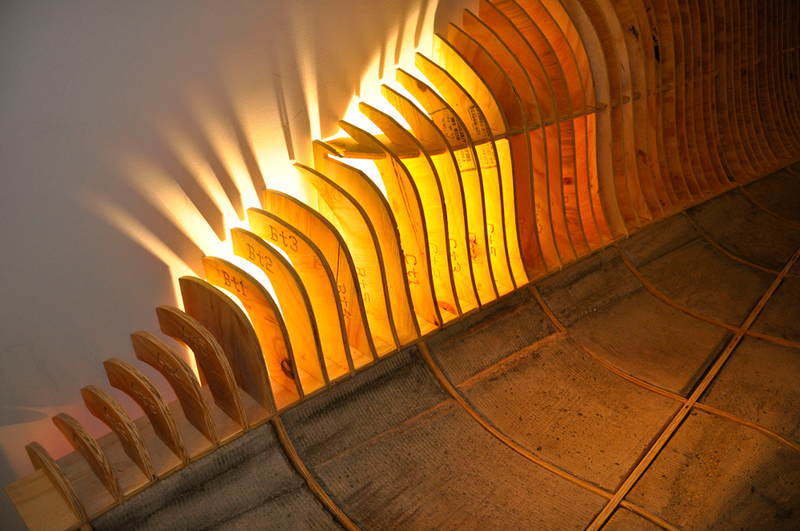
    skylar TIBBITS: This installation lines the concrete and glass hallway with hundreds of vaults, reminiscent of the great vaulted ceilings of historic cathedrals. The vaults provide a thickened surface articulation and a spectrum of oculi that penetrate the hallway and surrounding area with views and light. VoltaDom attempts to expand the notion of the architectural “surface panel,” by intensifying the depth of a doubly-curved vaulted surface, while maintaining relative ease in assembly and fabrication. This is made possible by transforming complex curved vaults to developable strips, one that likens the assembly to that of simply rolling a strip of material.

    [MORE]

  • reALIze
    los angeles CALIFORNIA

    suckerPUNCH: describe your project.

    oyler WU collaborative & michael KALISH: Designed as collaboration between Oyler Wu Collaborative and Michael Kalish, this traveling installation is built as a tribute to the life and cultural significance of Muhammad Ali. The project is aimed at exposing a new generation to this larger than life character by building an appreciation for the nuanced emotional, aesthetic, and technical principles that collectively form experience - a concept that holds true as much for human persona as it does for architecture.

    [MORE]

  • minimal complexity
    houston TEXAS

    suckerPUNCH: describe your project.

    vlad TENU: The project is the winner of the TEX-FAB REPEAT Digital Fabrication Competition.

    Minimal Complexity is the product of an architectural research focused on both the form-finding and the fabrication of minimal surface structures. The process was defined by an alternative algorithmic method based on the computational simulation of virtual soap films. The question that emerged was how the translation from the computational space to the build artifact could be embodied into this dual process.

    [MORE]