

Ads
Ads

Ads

Ads

Ads

Ads

Ads

Ads

Ads


  • Sylvia LAVIN, Kissing Architecture.
    2011

    Kissing Architecture explores the mutual attraction between architecture and other forms of contemporary art. In this fresh, insightful, and beautifully illustrated book, renowned architectural critic and scholar Sylvia Lavin develops the concept of “kissing” to describe the growing intimacy between architecture and new types of art—particularly multimedia installations that take place in and on the surfaces of buildings—and to capture the sensual charge that is being designed and built into architectural surfaces and interior spaces today.

  • Jane BURRY & Mark BURRY, The New Mathematics of Architecture.
    2012

    Architecture has always relied on mathematics to achieve visual harmony, structural integrity, and logical construction. Now digital tools and an increasing interest in physics have given architects the means to describe and build spatial constructs that would have been inconceivable even ten years ago. This carefully researched survey of 46 international projects offers an overview of how different strategies are being employed through accessible illustrations and clear text. Each section presents case studies of projects by globally recognized architects in diagrams, photographs, and texts.

  • Marcelo SPINA and Georgina HULJICH, Patterns Embedded.
    2011

    Marcelo Spina and Georgina Huljich are principals of the office PATTERNS founded in Los Angeles in 1999. The research and collaborative based approach of the practice seeks to move between digital and material expressions. PATTERNS describes its form-making as Driven by digital techniques and advanced computation. . . .

  • Peter COOK, ed., Drawing: The Motive Force of Architecture.
    2008

    Focusing on the creative and inventive significance of drawing for architecture, Drawing highlights the work of key contemporary figures who have, through their drawn work, affected the course of architectural thinking. Bringing this together is a chapter-by-chapter series of essays that broadly charts the forward movement and expansion of drawing iconography, techniques and methodologies. . . .

  • Patrik SCHUMACHER, The Autopoiesis of Architecture, Vols. I–II.
    2011–12

    Author Patrik Schumacher offers innovative treatment that enriches architectural theory with a coordinated arsenal of concepts facilitating both detailed analysis and insightful comparisons with other domains, such as art, science and politics. He explores how the various modes of communication comprising architecture depend upon each other, combine, and form a unique subsystem of society that co-evolves with other important autopoietic subsystems like art, science, politics and the economy. . . .

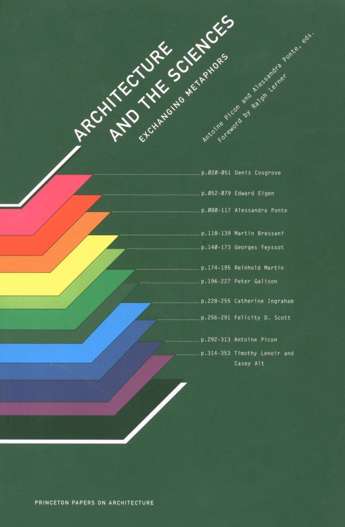
  • Alessandra PONTE & Antoine PICON, eds., Architecture and the Sciences.
    2011–12

    Since antiquity, the sciences have served as a source of images and metaphors for architecture and have had a direct influence on the shaping of built space. In recent years, architects have been looking again at science as a source of inspiration in the production of their designs and constructions. Architecture and the Sciences shows how scientific paradigms have migrated to architecture through the appropriation of organic and mechanical models. Conversely, architecture has provided images for scientific and technological discourse. Accordingly, this volume investigates the status of the exchanges between the two domains.