

Ads
Ads

Ads

Ads

Ads

Ads

Ads

Ads


  • Ingeborg ROCKER
    los angeles CALIFORNIA

    Ingeborg M. Rocker was appointed Associate Professor of Architecture at Harvard in 2011, after serving as assistant professor there since 2005. Rocker’s theoretical work is devoted to questions regarding the impact of media on the perception, production, and thinking of architecture. As a designer and teacher of design, she deploys computer modeling as a tool for giving form to theoretical hypotheses in a didactic way. Rocker’s ongoing research has been widely publicized through numerous international magazines and books.

    Ingeborg ROCKER, “Recursion: Aesthetics + Logics of Computation”
    intro. by Marcelo SPINA
    Wednesday, 04/03
    7.00 pm / W.M. Keck Lecture Hall
    SCI-Arc
    960 East 3rd Street
    Los Angeles, California 90013

  • Keller EASTERLING
    los angeles CALIFORNIA

    Repeatable formulas and spatial products make most of the space in the world now; not only buildings but also entire cities have become spatial products that typically reproduce free zone world cities like Shenzhen or Dubai. Space has become a mobile, monetized, almost infrastructural, technology, where infrastructure is not only the urban substructure, but also the urban structure itself.

    Keller Easterling is an architect, writer, and professor at Yale University.

    Keller EASTERLING, “Extrastatecraft”
    intro. by Marcelo SPINA
    Wednesday, 03/13
    7.00 pm / W.M. Keck Lecture Hall
    SCI-Arc
    960 East 3rd Street
    Los Angeles, California 90013

  • Flight Forms
    los angeles CALIFORNIA

    SCI-ARc, ESTm
    critics: Marcelo SPINA
    instructors, Robot House: Brandon KRUYSMAN & Jonathan PROTO

    suckerPUNCH: Describe your project.

    Peter VIKAR & Al ATAIDE: “Flight Forms” revisits early-’90s animation ideas of architecture in the Robotic Simulation environment of SCI-Arc. Inspired by Thomas Eakins’s Chronophotography studies of moving bodies in space our initial starting point was a “drone” that can fly independently. Based on its motion, nature of behavior, and momentum we have created a 3-D visual catalog, and motion library. This library was then placed in the robotic simulation environment where the flight paths were controlled to generate forms.

    [MORE]

  • Marcelo SPINA
    los angeles CALIFORNIA

    Marcelo Spina talks piling, flexible composites, the role of precedent and new media in architecture education today, SCI-Arc’s ESTm post-professional degree program, and much more.

    [CLICK FOR MARCELO SPINA INTERVIEW]

    [MORE]

  • Geode
    los angeles CALIFORNIA

    SCI-Arc, ESTm Studio
    Spring 2012
    critic: Marcelo SPINA

    suckerPUNCH: Describe your project.

    Steve MOODY: Two separate piles are scripted—one for the exterior that creates overall form and orientation, and one for the interior, accounting for circulation and the two main concert halls—and then intersected with each other. Discrepancies and misalignments between the two intersecting piles create cracks that form continuity between the two aggregations. Residual spaces in the poche between the two piles becomes support space for the theaters, administrative areas and educational and practice facilities.

    [MORE]

  • Nube
    los angeles CALIFORNIA

    SCI-Arc, ESTm
    critic: Marcelo SPINA

    suckerPUNCH: Describe your project.

    Amir HABIBABADI, Francisco MOURE, & Pablo OSORIO: Nube is Spanish for cloud. Nube is an architectural and engineering project to shield stadiums at the 2022 FIFA World Cup from direct sun exposure. Nube bases its design on the exploration of continuity, and motion. These ideas were conceived during the exploration and research of carbon fiber pre-preg tapes and composites components applied to large scale projects.

    [MORE]

  • Marcelo SPINA
    san luis obispo CALIFORNIA

    Marcelo Spina is a Design Professor at SCI-Arc and the Coordinator of the newly launched Emerging Systems and Technologies post-graduate program. Along with Georgina Huljich, Spina is the Principal of PATTERNS, a design research architectural practice based in Los Angeles that has gained worldwide recognition for its inventive approach to design and architecture, fusing advanced computation with an extended understanding of form, tectonics and materials. Recent commissions include pavilions for SCI-ARC and MOCA.

    Marcelo SPINA
    Friday, 02/01
    4.00–5.00 pm / 
Business Rotunda (03-213)
    Cal Poly — San Luis Obispo
    San Luis Obispo, CA 93405

  • Smoke Cloud: Revisiting the Pile
    los angeles CALIFORNIA

    SCI-Arc, MArch 2 Thesis
    critic: marcelo SPINA

    suckerPUNCH: Describe your project.

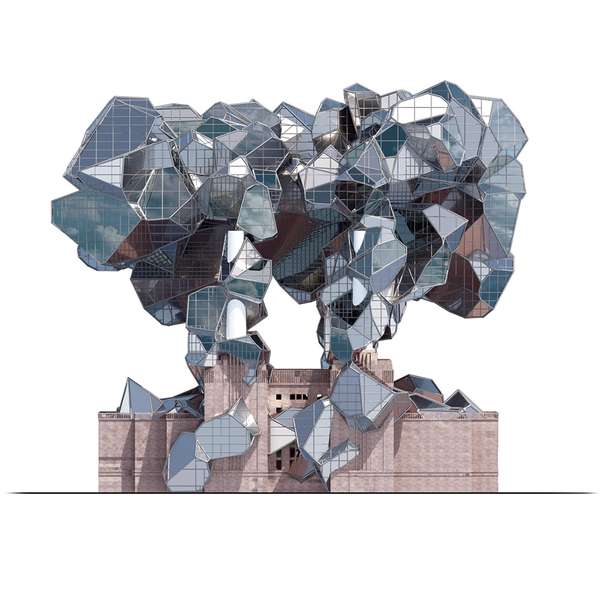
    YE li: This project is to use pile to create a complex accretion and a lumpy mass.

    There is a system. We can find them in mineral crystal, Starry Sky, flowers clusters and so on, it’s a kinds of disorder, a nature rule of aggregation. It’s pile like logic. Unlike the pre-decided order of stacking, piling’s components are random rotated and scaled. We can only identify this order by its holistic forms.

    [MORE]

  • Knitted Cloud
    los angeles CALIFORNIA

    SCI-Arc, ESTm Final Studio
    critic: marcelo SPINA

    suckerPUNCH: Describe your project.

    mehrzad RAFEEI & somayyeh RAMEZANI: Contemporary digital design has always had a certain disconnection with its possible physical incarnation. Abstracted away from material properties, digital geometry floats in Euclidean space unaware of the physical constraint of what it represents. Our project attempts to bridge that divergence.
    [MORE]

  • PUCPR Student Dormitory
    los angeles CALIFORNIA

    suckerPUNCH: Describe your project.

    P-A-T-T-E-R-N-S: This building is a proposal for a 120-bed student dormitory for the Pontificia Catholic University of Puerto Rico in Ponce, the second largest city of the island and the old capital before San Juan. As part of a larger master plan aiming to attract students from the whole Caribbean region and fulfill the current demand of 500 apartments, the proposal aims to create a new presence within the campus. Articulating a vertical mass with a figural void that encapsulates the main social areas of the program, our proposal aims to induce human interaction among students and visitors in a vertical environment while enhancing unprecedented urban vistas from and to the historic center of the city just beyond the university campus.

    [MORE]