Ads
Ads

Ads

Ads

Ads

Ads

Ads

Ads

Ads

Ads

Ads


  • Noise Scape II
    berlin GERMANY

    suckerPUNCH: Describe your project.

    Holger LIPPMANN: The fractalScape and NoiseScape series are based on Processing code and work with Perlin noise and iteration functions. The iteration algorithm divides a shape down within a 7-9 level loop. Each repetition of the process is also called an “iteration.” The results of one iteration are used as starting point for the next iteration.

    [MORE]

  • Surface Translations / Pleated Perforated Bridge
    vienna AUSTRIA

    suckerPUNCH: Describe your project.

    claudio GRANATO, dino KIRATZIDIS, & cecilia SANNELLA: The Atlas of Sensations was a 4 week summer school at The University of Applied Arts in Vienna. The brief was to design a pedestrian bridge near the Urania building in Vienna. Our project looked at techniques of producing highly articulated, “pleated” surfaces. This was achieved by moving between the software platforms, which was one of the objectives of the course: we modeled in Maya, deformed the generic mesh (a tube, with apertures) with Processing; further edited the deformed geometry in Maya to adapt to the site; and produced gradients and perforations in Grasshopper to produce atmospheric effects inside the tube.

    [MORE]

  • Fallen Star @ AA DLAB
    london UNITED KINGDOM

    suckerPUNCH: Describe your project.

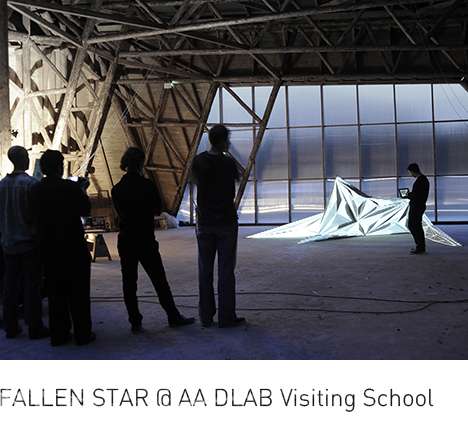
    Architectural Association (AA) DLAB Visiting School: “Fallen Star” is an installation set between biomimetics, interaction, and perception. It is the final working prototype of the Architectural Association (AA) DLAB Visiting School, which took place in AA London and AA Hooke Park during 23 July–05 August 2012. AA DLAB 2012, “Green,” explored the concepts of regeneration, emergence, and growth through their broad existence in natural and biological structures of differing scales, followed by their abstraction and interpretation into elaborated design proposals. The computational toolset of the workshop has been Processing, Grasshopper, and iPad or iPhone.

    [MORE]

  • Milieus and Algorithms
    boston MASSACHUSETTS

    suckerPUNCH: Describe your project.

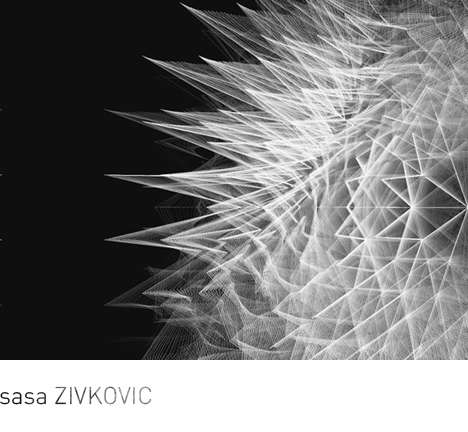
    sasa ZIVKOVIC: Milieus and Algorithms examines the relationship between geometry generating algorithms and algorithm controlling milieus. Processing, an open software project developed by Casey Reas and Ben Fry at MIT Media Lab is used to establish a set of rules for growth and expansion of geometries (algorithms) while at the same time allowing to constantly alter the conditions which determine how geometries grow in real time (milieus).

    [MORE]

  • Embryologics_1/ Chess Table 1
    brooklyn NEW YORK

    suckerPUNCH: Describe your project.

    m. casey REHM (Kinch): This is a series of sketches that is part of a larger project dealing with issues of agency and figure. I use short exercises like this with specific and internal constraints which operate in a conceptual vacuum to develop behaviors and methods with the intention of later integrating them into architectural projects which have a more complex set of constraints already built into them. This particular study links a genetic growth trigger with an agent population which has a topological understanding of its population as well as simulated material behaviors.

    [MORE]

  • Plethora-Project
    london UNITED KINGDOM

    Plethora-Project.com is an initiative to accelerate computational literacy in the frame of architecture and design. It aligns with the “show me your screens” motto of the TopLap live-coding group attempting to get rid of Obscurantism in digital design.

    Directed by Jose Sanchez.

    [PLETHORA PROJECT]
    [VIMEO]
    [YOUTUBE]


  • philadelphia PENNSYLVANIA

    suckerPUNCH: describe your project.

    david EATON, geoffrey KLEIN & michael WETMORE: The objective in designing Living Bridge was to describe a new type of nonlinear architecture through the design of an inhabitable bridge in Tokyo. The chosen site integrates with the residential neighborhoods of Ginza and Tsukishima. Through the harnessing and intensification of the discrete flows of the two neighborhoods, and through algorithmic generation of turbulent spatial and programmatic structures, a reinvention of the inhabitable bridge type is achieved.

    [MORE]

  • casey REAS
    los angeles CALIFORNIA

    casey REAS is giving a lecture at kerckhoff hall, 734 west adams boulevard, los angeles 90089, at 6 pm on wednesday 17 february 2010. admission free. this event is part of the voices and visions usc arts and humanities initiative.

    subsequently he will be giving a series of workshops on processing in the institute for multi-media literacy blue lab, 734 west adams boulevard, 12 noon – 3 pm on fridays 19 february, 26 february and 5 march. registration is required for the workshops. contact: imlrsvp@cinema.usc.edu.

    [MORE]