

Ads
Ads

Ads

Ads

Ads

Ads

Ads

Ads

Ads

Ads


  • Overmining, Objects in Objects on Objects
    philadelphia PENNSYLVANIA

    University of Pensylvania, PennDesign
    critics: Tom WISCOMBE & Nate HUME

    suckerPUNCH: Describe your project.

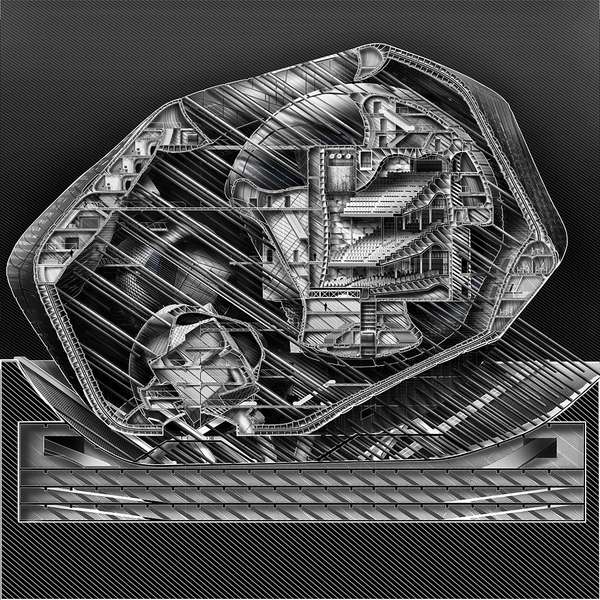
    Andreas KOSTOPOULOS & Avra TOMARA: How can we reinvent the “sectional object”? The “box-within-a-box” architecture serves as an alternative to the homogeneous Modern free plan and section. The inner “box” or figure, incongruent with its envelope, creates complex interstitial spaces which deny homogeneity. “Blankness,” the resistance of the mass to external referents such as ornamentation or formal recognition is of high importance. External surface and internal programs are loose and non-linearly correlated, the skin is definitely a loose-fit envelope.

    [MORE]

  • Imago Mundi
    brooklyn NEW YORK

    Pratt Institute
    critic: Karl CHU with Michelle FOWLER

    suckerPUNCH: Describe your project.

    Thomas LEE & Gillian SHAFFER: Kantian mysticism? Duality in mind dependence of the human subjectivity inside the absurdity of existence, or the monist, metaphysical fabric supported by the scientific method in search of Truth? Determinism or the stochastic system of choice?

    [MORE]

  • Ash Park
    chicago ILLINOIS

    University of Illinois at Chicago
    critic: Grant GIBSON

    suckerPUNCH: Describe your project.

    Ryan HERNANDEZ: How societies build for death varies and offers deep and solemn investigations into narrative, identity and form. We will earnestly deal with these topics with light and whimsical hearts.

    Each figure in the continuous field is 20 ft. tall with a volume of 115 cu.ft. and constructed of poured in place concrete requiring 50 gal. of water, 300 lbs of cement, 800 lbs of fine aggregate (Human ash and sand). One human corpse produces 5 lbs of ash and one figure requires 60 humans. An average of 150,000 deaths in New Orleans (site: New Orleans, Old Algiers) can create 208 figures a month.

    [MORE]

  • The New Painterly
    los angeles CALIFORNIA

    SCI-Arc
    critic: Andrew ATWOOD

    suckerPUNCH: Describe your project.

    Austin SAMSON & Danny KARAS:
    Painting: The project revolves around the idea of using the Chiaroscuro effect as a way to create and manipulate three-dimensional space within a two dimensional drawing or image. This is done by using conventional drawing techniques, such as hatching, in new ways to represent shade and shadow. The layering of these hatching techniques may either enhance shadow, produce fake shadow (where shade is literally painted on) or flatten areas of the image in order to produce moments of ambiguity within each drawing.

    [MORE]

  • Daegu Gosan Library
    hong kong CHINA

    suckerPUNCH: Describe your project.

    Łukasz WAWRZEŃCZYK, Frisly COLOP MORALES, Jason EASTER, & Adrian YAU: The cultural importance of the public library lies within the inherent power of the knowledge which it holds. This knowledge can be a significant life-altering force for the patrons of the library and furthermore within the larger community which it serves. The methods by which this information is contained and transmitted are continually evolving, yet the correlation between access to such information and issues such as upward social mobility and increased life opportunity are evident.

    [MORE]

  • Eccentric Housing
    los angeles CALIFORNIA

    SCI-Arc
    critic: Ramiro DIAZ-GRANADOS

    suckerPUNCH: Describe your project.

    Spike LIU & Mark A. SANTA INES: As an object on the block, our interest was to develop a unit interlocking strategy that would integrate in section, composing neighborhoods within a hinged bar, collectively coming together as a massing that would remain undefined as a housing project.

    [MORE]

  • Gradient Tower | The new Cooper Union School of the Advancement of Science and Art
    atlanta GEORGIA

    Georgia Institute of Technology, School of Architecture
    critic: Volkan ALKANOGLU

    suckerPUNCH: Describe your project.

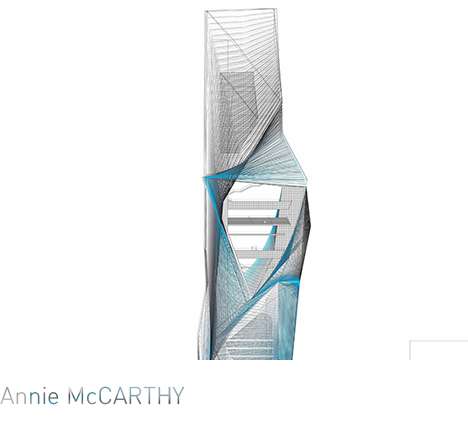
    Annie McCARTHY: The design of a new Cooper Union vertical campus challenges notions of extrusion of floor plates in the tower typology by thinking of both formal and programmatic organization as discrete chunks. How can Cooper Union situate itself in a vertical context, and how does that relate to formal chunking in a tower? In fact, it is in a similar way to how Cooper Union organizes itself in current lateral relationships in the Manhattan grid—on the cusp of two colliding grids.

    [MORE]

  •  Turning Heads - The Pictorial Figure
    los angeles CALIFORNIA

    SCI-Arc
    critic: Florencia PITA

    suckerPUNCH: Describe your project.

    Kyle ONAGA: The figure in architecture is neglected and feared. This thesis embraces the figure.
    The exploration seeks an alternative starting point for architecture that does not originate from abstracted forms.
    Using a literal figure as massing, the head is taken as the architectural primitive.

    The figure in its nature, has apriori associations. In its reading, the figure creates an engagement.

    [MORE]

  • King Abdullah Financial District Metro Station
    london UNITED KINGDOM

    The King Abdullah Financial District (KAFD) Metro Station will serve as a key interchange on the new Riyadh Metro network for Line 1, as well as the terminus of Line 4 (for passengers to the airport) and Line 6. The local monorail can also be accessed from the station via a skybridge. With six platforms over four public floors and two levels of underground car parking, the KAFD Metro Station will be integrated within the urban context of the financial district, responding to the functional requirements of a multimodal transport centre and the district’s future vision.

    [MORE]

  • Einfamilienhaussiedlung
    innsbruck AUSTRIA

    Institute of Urban Design, University of Innsbruck
    Peter TRUMMER

    suckerPUNCH: Describe your project.

    Moritz KEITEL: The project einfamilienhaussiedlung questions how the individual rooms a house consists of, relate to each other and to the collective system of a colony. The distinct shapes of the houses are not predetermined fixed space-envelopes. But the result of an associative model of relationships existing between the rooms within each of the houses as well as between the different houses themselves. Although creating a group-form, the houses as such remain single and distinct entities.

    [MORE]