




Ads
Ads

Ads

Ads

Ads

Ads

Ads

Ads


  • vienna AUSTRIA

    suckerPUNCH: describe your project.

    nora graw & maja ozvaldic & martina lesjak: the concept is based on exploration of the sectional relationship between inside and outside. the massing, with its orientation, reacts on the city and coast line and creates a diverse set of spatial conditions along the “s” axis. the building as a sequence, deals with the interweaving of two major components: plenum and shell. the designed pattern for the structural plenum reacts to the sun angles in terms of its depth, density and the way it is tilted. this creates not only a visual effect on the façade but different lighting conditions and shading in the building.

    [MORE]


  • vienna AUSTRIA

    peter VIKAR: this project explores a thick structural facade system for a contemporary library in downtown of budapest. from one side it reinvents the operation - books are being locally printed and not stored - and relation to physical content, and at the same time it shifts the usage of the library towards a more city, and event oriented direction.

    [MORE]

  • superintendent tendencies
    vienna AUSTRIA

    suckerPUNCH: descibe your project.

    julia KOERNER +adam VUKMANOV + miljan RADOJEVIC: the project explores figure to figure relationships and their deformations caused by dynamic wind forces. it rigorously addresses the context of the site, cres/croatia, by nesting the volumes in linear production system and orientation dependent on existing winds which are the parameter of latent mutability and transformation of the shapes. volumetric continuity achieved by multi materiality, surface creasing, seams and structure porosity is defining the complexity of sustainable architectural processes incorporated within the building.

    Boat Fabrication Yard
    Greg Lynn Studio SS2008

    [MORE]


  • los angeles CALIFORNIA

    sci-arc: blobwall pavilion is a collaboration between greg lynn form, machineous who developed the manufacturing method for the “bricks” and panelite who produced and distributed the architectural material. it is an innovative redefinition of the brick – architecture’s most basic building unit – into a lightweight object made of colorful plastic and reinterpreted into modular elements. the blob unit, or “brick,” is a robotically cut mass-produced hollow tri-lobed shape formed through rotational molding, which is then assembled with interlocking precision to form the wall. the blobwall pavilion is a contemporary wall system that recovers the voluptuous shapes, chiaroscuro and grotto-like textures of baroque and renaissance architecture in pixilated gradients of vivid color. on three walls of the installation, custom fabricated acrylic bubble cabinets will be installed to display small objects.

    [MORE]

  • juno
    vienna AUSTRIA

    suckerPUNCH: describe your project.

    julia KOERNER + nora GRAW: designed from the inside of an intricate large single surface space, organized through a strategy of nesting and poché, to a three dimensional structural volume, which creates blurred depth through a gradient from relief to structure, dependent on the distance of the inner volume to the outer skin, which let the focus on the volumes or parts of it fall off gradually until they disappear in depth.

    [MORE]

  • architectural laboratories
    2003

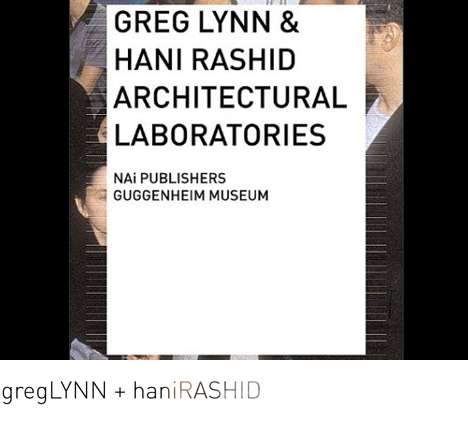
    nai publishers: together with a select group of international students from columbia university and the university of california, los angeles, highly respected architects and architectural theoreticians hani rashid and greg lynn transformed the united states pavilion during the venice biennale 2000 into a four-week workshop and forum for architectural discourse: a laboratory. investigating, producing, and reviewing a variety of architectural schemes, the participants demonstrated the practice and direction of a new generation of architects. “architectural laboratories” presents the results of this workshop through 10 projects that focus on the themes “the embryologic house” and “augmented architecture.” guest critiques of the students’ designs are offered by philosopher and cultural critic mark c. taylor, zkm chairman peter weibel, and max hollein, the united states commissioner for the biennale.


  • 1999

    greg LYNN’S influential essay from the late nineties was a great primer on the introduction of new approaches in architecture brought on by animation software and the shift brought on by the ability to design using calulus and topological surfaces in cad programs. ideas from bergson, deleuze, leibniz, d’arcy thompson, shippbuilding and many other influences are synthesized together to create a coherent approach through which to access digital design and its potentials. the essay also describes and presents much of the terms important to architecture at the time including keyframing, blobs, warps, forces, virtual, particles, dynamics, and gradients.


  • 1993

    morphing, deleuze, terminator 2 and all the other ingredients which would usher in the first digital age in architecture are here in this seminal book published in 1993. the book marks the shift in tendencies from deconstructivist to topological. early projects by greg lynn and thomas leeser as well as mid career work by peter eisenman and essays by john rachjman and jeff kipnis proved to be a powder keg of inspiration as architects began to take on the computer and new ideas.

  • bionomic precipitousness
    vienna AUSTRIA

    suckerPUNCH: describe your project.

    adam VUKMANOV: deformation and differentiation of facade are generated with air intakes and their volume considering the height pressure difference. also, the double skin is shifting and reacting to the direct sun exposure depending on the angle, as well as behaviour and angularity of the wind/air stream on the exterior surface which is precisely calculated with computer-fluid-dynamic software.

    studio greg LYNN, die angewandte, vienna, austria

    thesis project summer 2009

    [MORE]


  • vienna AUSTRIA

    suckerPUNCH: describe your project in one sentence.

    julia KOERNER: the design of the thesis project ‘superhuman enticement’, situated on manhattan’s east river, demonstrates how an artificial paradigm change can be exploited for both generalization and specification of therapy and factory building typologies as well as formal beauty, enigmatic effects and organic aesthetics in architecture.


    [MORE]