



Ads
Ads

Ads

Ads

Ads

Ads

Ads

Ads


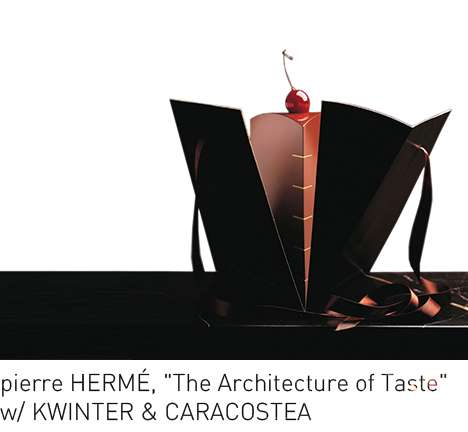
  • Pierre Hermé, The Architecture of Taste. Photo: Jean Louis Bloch Lainé
    cambridge MASSACHUSETTS

    Pierre Hermé, widely considered as today’s foremost pastry chef, will expose three of his creations, retracing them from their original intuition to the elaboration of their flavors, textures, and formal manifestations, ultimately giving each its own character and ability to provide us with a new way of discovering the world.
 . . . His work demonstrates a rigor and sensibility that have created a new grammar whose richness is in line with the growing interest in cross-disciplinary thinking in design fields—laying foundations of what can be called the Architecture of Taste.

    Pierre Hermé, “The Architecture of Taste”
    w/ Sanford Kwinter and Savinien Caracostea
    Tuesday, 11/27
    6.30 pm / Piper Auditorium, Gund Hall
    Harvard GSD
    48 Quincy St.
    Cambridge, MA

  • re[BLUR]2.0
    cambridge MASSACHUSETTS & los angeles CALIFORNIA

    suckerPUNCH: Describe your project.

    qi SU & jili HUANG: [re]BLUR 2.0 could be interpreted in two different ways.

    Theoretically, it is an initiative to help people to identify and differentiate their physical presents from their digital lives. It is a device with which people could discover the occupancy of the cybernetic part in their mind. It is also an incubator that bring up the opportunities of encountering and contingency.
    Formally, it is a labyrinth built up with hundreds of the “water stalactites.” It is a container within which there are vague boundary between illusion and reality. It is also an experiment field where the refraction of lights is manipulated following the design of the continuous transparent surface.

    [MORE]

  • nathalie de VRIES
    cambridge MASSACHUSETTS

    Nathalie de Vries co-founded the architectural and urban design practice MVRDV in 1993 in Rotterdam, the Netherlands. The MVRDV design process makes use of collaboration across many disciplines to create new and engaging uses of urban space. Nathalie de Vries and MVRDV’s work has been published worldwide and obtained international awards, and de Vries has been Guest Professor at TU Berlin and Visiting Professor at IIT Chicago, as well as Supervisory Architect for the Nederlandse Spoorwegen / ProRail. Nathalie also serves on the Supervisory Boards of the Institute for Dutch Creative Industry, the Netherlands Architecture Institute (NAi), and theMuseum of the Image (MOTI).

    Nathalie de Vries
    Friday, 11/04
    4.00 pm / Piper Auditorium, Gund Hall
    Harvard GSD
    48 Quincy St.
    Cambridge, MA

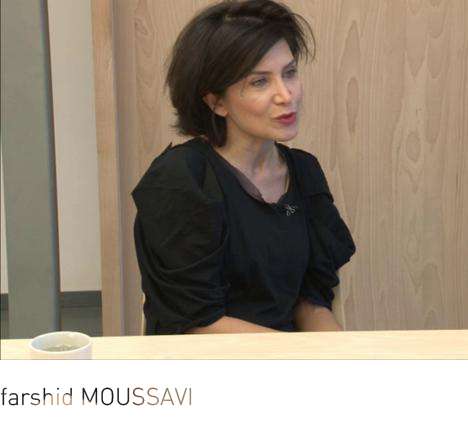
  • farshid MOUSSAVI
    cambridge MASSACHUSETTS

    Farshid Moussavi is Principal of Farshid Moussavi Architecture in London. Her firm, founded in 2011, specializes in projects that integrate architecture, urbanism, and landscape design. Her current work includes the Museum of Contemporary Art in Cleveland, Ohio, and a Quran Museum in Tehran. Moussavi is Professor in Practice at the Harvard GSD and was a founding partner in the award-winning firm Foreign Office Architects (FOA), established after it won the competition to build the Yokohama International Ferry Terminal in Japan in 1995.

    farshid MOUSSAVI, “Style Agency”
    Thursday, 10/25
    6.30 pm / Piper Auditorium, Gund Hall
    Harvard GSD
    48 Quincy St.
    Cambridge, MA


  • cambridge MASSACHUSETTS

    Liminal Objects initiates a conference series about design that aims to identify pressing issues within the field by exploring the designed object’s role in diverse spatial practices. Through carefully crafted discussions between designers, critics, curators and business leaders, the conference will approach design from differing points of view, studying the production of design, design in practice, and ways that institutions shape design through exhibitions and commissions. The discussion will culminate in a round table with GSD faculty and invited guests.

    “Liminal Objects”
    Friday, 10/19
    3.00-8.00 pm / Piper Auditorium, Gund Hall
    Harvard GSD
    48 Quincy St.
    Cambridge, MA

    [MORE]

  • toyo ITO
    cambridge MASSACHUSETTS

    The “Metabolism” movement in the 1960s has established the foundation for the emergence of Japanese contemporary architecture up till this day. The architectural and urban projects for the future, created by one of the Metabolists—Kiyonori Kikutake—still retain their luster in current times. In this lecture, Toyo Ito will consider Metabolism’s significance today through Kikutake’s works.

    Toyo Ito, “What Was Metabolism?: Reflections on the Life of Kiyonori Kikutake”
    Tuesday, 10/16
    6.30 pm / Piper Auditorium, Gund Hall
    Harvard GSD
    48 Quincy St.
    Cambridge, MA

  • Video Can't Kill the Radio Star
    cambridge MASSACHUSETTS

    suckerPUNCH: Describe your project.

    ben BRADY: This thesis aims to explore the tension prevalent in tody’s libraries from all scales. Video cannot kill the radio star. Despite promises of obsolescence of one technology over another, we must realize that this is never the case. Video didn’t kill radio. Photography didn’t kill painting. Film didn’t kill the theater and the age of digital information will not kill the book and the library. “This” doesn’t kill “that,” but rather “that” may be re-defined by “this.” The library is at a unique place today as facing head-on the power, speed, and mobility of the digital world, while simultaneously being burdened by its own immense physicality.

    [MORE]

  • coFLEXions: A Responsive Inflatable
    cambridge MASSACHUSETTS

    Harvard GSD
    critics: mariana IBAÑEZ & simon KIM

    suckerPUNCH: Describe your project.

    brandon CUFFY, judy FULTON, & stacy MORTON: CoFLEXions is a responsive inflatable that creates a unique connection between the individual user, the collective, and a spatial environment. This responsive inflatable is a project that tests the implications of responsive architecture through formal and spatial means. As responsive technologies become readily accessible to architects and designers, they provide an opportunity for users to have unique agency over their spatial environments.

    [MORE]

  • Of the Senses
    cambridge MASSACHUSETTS

    suckerPUNCH: Describe your project.

    glen j. SANTAYANA: In imagining the architecture of the future, I thought about the current trend that technology plays in our lives today, mainly referring to the heavy consumption of social media networks, status updates, and monitoring the latest trends. We are constantly plugged in; developing a relationship between ourselves, the viewing apparatus, and the virtual world. This perpetual fix to our device has generated a culture in which human qualities and interaction between one another have subsided and declined. As a result, I am interested in human qualities and its role in the architecture of the future through methods of emotional and sensorial inquiries.

    [MORE]

  • Light Monumentality
    cambridge MASSACHUSETTS

    suckerPUNCH: Describe your project.

    glen j. SANTAYANA: The new Seoul international train station addresses the studio’s theme of ‘light monumentality’ through its monumental ‘classical’ entry sequence and overall size. While at the same time carrying a quality of lightness in the overall structural make-up and programmatic visual perception and deception.

    [MORE]