


Ads


Ads


Ads


Ads


Ads


Ads


Ads


Ads


  • cambridge MASSACHUSETTS

    suckerPUNCH: describe your project.

    lee-su HUANG + gregory thomas SPAW: inspired by the economic effectiveness of commercial plastic packaging, osnap! attempts to exploit the inherent advantages of widespread current technologies. vacuforming facilitated immediate testing and the ability to mass-produce units for an effective evaluation of performance. digital fabrication techniques ensured the consistent precision and quality of the working molds, allowing for fast turnaround times in iterative design development and proofing of concepts. together, these processes facilitated an exploratory approach to different joinery techniques, geometries, and streamlined production.

    [MORE]

  • digital tectonics: robotic fabrication
    pittsburgh PENNSYLVANIA

    team: arthur AZOULAI, nelly DACIC, jared FRIEDMAN, christopher GALLOT,spencer GREGSON, matthew HUBER, jaclyn PACELEY, puja PATEL, rita, craig ROSMAN, giacomo TINARI, eddie WONG

    suckerPUNCH: describe your project.

    this is the work of undergraduate architecture students in the digital tectonics course at carnegie mellon university, taught by jeremy FICCA and zach ALI.

    [MORE]

  • +size
    chicago ILLINOIS

    suckerpunch: describe your project.

    thomas KELLEY: +size is one of six temporary installations currently on exhibit in southwest chicago’s showpod galleries. the brief required each designer to make use of a single ream [500 sheets] of standard 8.5″ x 11″ paper [95 bright, 24lb]. both concept and fabrication took place in a two week time frame.

    [MORE]

  • chromaesthesiae
    new york NEW YORK

    softlab presents CHROMAesthesiae
    an installation of modular color
    opening: 7 p.m., friday, march 19th, 2010 until april 5th, 2010.
    location: devotion gallery 54 maujer st, brooklyn, ny, 11206 (l to lorimer/metropolitan)
    website: areyoudevoted.com

    [MORE]


  • novi sad SERBIA

    student group a7: project presents both space installation and utilitarian object (part of furniture), designed and carried out with anthropological measures with 5 seating places. concept of sustainable development is consistently implemented throughout all phases of project, from selection of materials for processing, to final construction. cardboard plates are used, thickness 0.5cm, hand made and assembled in layers.these layers form structure which is geometrically shaped looked from outside (part of cube), and amorf inside. cardboard as material is suitable for processing, friendly for touch and renewable (recycling process can be repeated many times).

    [MORE]

  • 366 (Emily Dickinson's Miraculous Year)
    new york NEW YORK

    spencer FINCH: this work is based on the year 1862, emily dickinson’s annus mirabilis, when she wrote an amazing 366 poems in 365 days. it is a real-time memorial to that year, which burns for exactly one year. the sculpture is comprised of 366 individual candles arranged in linear sequence, each of which burns for 24 hours. the color of each candle matches a color mentioned in the corresponding poem; poems in which no color is mentioned are made out of natural paraffin.

    [MORE]

  • wall of paper
    atlanta GEORGIA

    instructor: jennifer BONNER
    georgia tech, college of architecture

    suckerPUNCH: describe your project.

    jennifer BONNER: the project is a culmination of 27,000 sheets of recycled paper, four sheets of birch plywood, and the charting of 100 years of student population within the architecture school.

    [MORE]


  • new york NEW YORK

    layers of paper build up in charles CLARY’S compositions to appear as mutant rose windows hiding behind gallery walls. the color gradient created by the changing shades within the stacks amplifies their depth and gives the clusters a pop as they replicate and spread across the room.

    [MORE]

  • an architecture of humor
    paris FRANCE

    “an architecture of humors” is a research project / exhibition in which the r&sie[n] architectural practice has worked with a group comprised of a mathematician, programmers, architects, and a robotics designer to develop a computational approach based on biological and physiological data scanned from visitors who are put through situations inciting repulsion, stress and pleasure to conceive housing units and urban fragments based on relational protocols.

    from january 22 through april 26 2010 at le labotatoire, 4 rue du bouli, 75003 paris

  • lux nova
    brooklyn NEW YORK

    suckerPUNCH: describe your project.

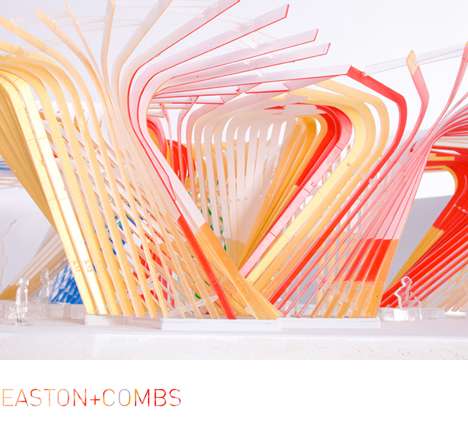
    lonn COMBS + rona EASTON: the story of the rise of stained glass use in religious gothic architecture served as an important analogy for our design approach. we were intrigued by the idea that stained glass was a material technology which was much older when it was first experimented with as a window material. it was the desire to extend the idea of painterly narrative across the window portal that lead to a breakthrough in it’s use and widespread subsequent adaptation in religious (collective) gothic architecture. hence, without the need for social narrative to extend the painterly surface of architecture across the window portal of the gothic church the breakthrough of material innovation and novel application would not have taken place then.

    [MORE]