


Ads
Ads

Ads

Ads

Ads

Ads

Ads

Ads

Ads

Ads

Ads


  • Gimme More
    new york NEW YORK

    From February 21 to March 2, 2013, a new exhibition will enable visitors to explore the link between the physical & digital worlds via augmented reality–based immersive installations that fascinate, engage, and delight. The “Give Me More” exhibition was created by Swiss design EPFL+ECAL Lab and was awarded the DMY International Design Festival Berlin Prize 2010. Previous incarnations of the exhibition have travelled to London, Milan, Paris and San Francisco, but the New York exhibition, designed in collaboration with SOFTlab studio & Laetitia Wolff of futureflair, features 7 installations with new contributions from several designers.

    “Gimme More”
    opening: Thursday, 02/21
    6.00 pm / Eyebeam
    540 West 21st St.
    New York, NY 10011

    [MORE]

  • Stereoscopic Inundation Workshop
    copenhagen DENMARK

    CITA Studio, January 2013
    tutors: Adam VUKMANOV & Martin TAMKE
    Center for Information Technology and Architecture
    Royal Danish Academy of Fine Arts, Copenhagen, Denmark

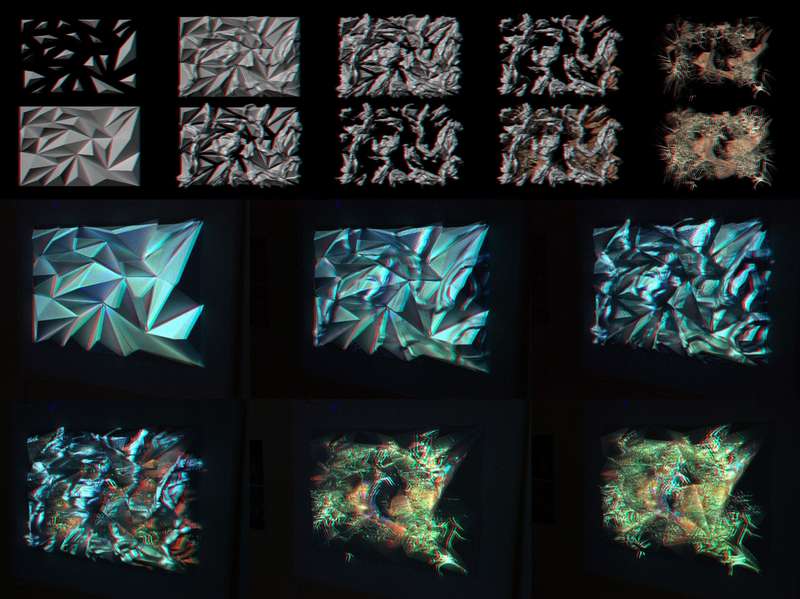
    Stereoscopic Inundations—a 5 day research based workshop at CITA.studio,was exploring erosion, alluvions, decomposition and related processes which are key to the formation and transformation of organic and man-made environments during flooding periods.

    [MORE]

  • Shenzhen University Parametric Methodology Pavilion
    shenzhen CHINA

    suckerPUNCH: Describe your project.

    Cho CHUNG MAN, WANG Yang, YANG Zhenyuan, & Jaenes BONG: This pavilion should be an icon of the parametric movement in SZU, located at the prime location of the department. It represents an atypical and unusual construction techniques that exhibit the superior technical knowledge through a research and exploration methodology. The pavilion should consider in a holistic manner from conceptual idea to digital modeling until on-site construction.

    [MORE]

  • Ben van BERKEL
    los angeles CALIFORNIA

    “The profession of architecture has expanded and now finds itself in a position to engage with a broader series of cultural references. The architect can now refer to film, fashion, literature, philosophy, music, art etc. and as such greatly enrich the cultural side of the profession. However with such an exclusive focus, the functionality of architecture—the rational and scientific side of the profession—is sometimes forgotten. As there is still much to discover in these more pragmatic areas of the practice, I believe that in the future the profession will become increasingly oriented towards knowledge and expertise . . .”

    Ben van BERKEL, “Architecture and its Future”
    intro. by Eric Owen MOSS
    Wednesday, 02/20
    7.00 pm / W.M. Keck Lecture Hall
    SCI-Arc
    960 East 3rd Street
    Los Angeles, California 90013

  • geoCOMB
    innsbruck AUSTRIA

    University of Innsbruck, studio3 / institute for experimental architecture
    critic: Michael WIHART

    suckerPUNCH: Describe your project.

    Elias WALCH: “Goosebumps [in]dependent, synesthetical experiences in organ recital vault, New York.” My ambition in this project was to force the extension of haptic perception in a world which is dominated by visual impressions. This tactile perceptions are supported by music respectively by the musician, protORGANist, who operates directly on the human body and its skin to stimulate emotional levels. The spectators are embedded in a soft structure, called pneumoSPONGE.

    [MORE]

  • Heterotopic Gardens_CHIMERA. adaptive multiplicity
    brooklyn NEW YORK

    Pratt Institute
    critic: Ezio BLASETTI

    suckerPUNCH: Describe your project.

    Sofia XANTHAKOU, Greg LeMAIRE, & Dimitris MOUSTROUFIS: The project is an overall premise concerning an intervention into the conventional city fabric and the repeal of commonly acknowledged truths about urbanism. Arguably ideas about flow, ownership and occupation are the most closely guarded and regulated within a community and therefore are the most in need of confrontation. By imposing adverse conditions and forms on rigid expectations we hope to create a dialogue about an alternative to accepted norms.

    [MORE]

  • Philippe BLOCK

    london UNITED KINGDOM

    This lecture will present new computational form-finding approaches for exploring three-dimensional equilibrium shapes, by understanding Gothic masonry vaults. Through the use of intuitive graphical methods, the designer gains control over the exploration of form, which blurs the boundaries between funicular (compression-only) and free-form design.

    Philippe BLOCK, “Stone Skins: New masonry shells”
    Tuesday, 02/19
    6.00 pm / Lecture Hall
    Architecture Association
    36 Bedford Square, London WC1B 3ES

    [MORE]

  • Marcelyn GOW
    los angeles CALIFORNIA

    Within a discipline where the exact translation of virtual instructions, in the form of drawings or codes, to their material actualization has historically played a decisive role, the current use of algorithmic design tools and computer numerical control (CNC) fabrication technologies would seem to all but eliminate the possibility for exactitude to submit to some external corrupting influence. Paradoxically, the seduction of algorithmic precision has become partially exhausted in the fulfilled promise of its own fidelity. The absolute control of geometry and its materialization suppresses the potentiality of that which exceeds the firmitas, or solidity, of inert matter. . . .

    [READ ON]

    [MORE]

  • Hernan DIAZ ALONSO
    los angeles CALIFORNIA

    Hernan DIAZ ALONSO speaks on depth versus density, architecture’s engagement with contemporary culture, maintaining originality in a sea of copycatting, tackling the mathematical perfection brought about by the computer, and much more.

    [CLICK FOR HERNAN DIAZ ALONSO INTERVIEW]

    [MORE]

  • Flight Forms
    los angeles CALIFORNIA

    SCI-ARc, ESTm
    critics: Marcelo SPINA
    instructors, Robot House: Brandon KRUYSMAN & Jonathan PROTO

    suckerPUNCH: Describe your project.

    Peter VIKAR & Al ATAIDE: “Flight Forms” revisits early-’90s animation ideas of architecture in the Robotic Simulation environment of SCI-Arc. Inspired by Thomas Eakins’s Chronophotography studies of moving bodies in space our initial starting point was a “drone” that can fly independently. Based on its motion, nature of behavior, and momentum we have created a 3-D visual catalog, and motion library. This library was then placed in the robotic simulation environment where the flight paths were controlled to generate forms.

    [MORE]