





Ads
Ads

Ads

Ads

Ads

Ads

Ads

Ads

Ads

Ads


  • Hyper Ornamentation Series
    new york NEW YORK

    suckerPUNCH: Describe your project.

    Johnny C. LIN: The series of projects presented here is the result of an on-going exploration of the transformative nature of surface quality. The work is inspired by the complexity, opulence and drama of Gothic cathedrals and Baroque architecture. The second influence is the industrial space. Factories are significant here because their existence primarily rooted in functional necessities and the requirements for mass production. The Industrial Era signified the shift of power in human consciousness from God as an omnipotent figure to that of men.

    [MORE]

  • Vitreous
    houston TEXAS

    A shape, a volume, a color, a surface is something itself. It shouldn’t be concealed as part of a fairly different whole.
    —Donald Clarence Judd (1928–94)

    The collaboration between the Judd Foundation (Marfa, Texas) and the course is to further investigate, critically examine, and apply both theoretical study and practical design-research into the highly debated idea of “delegated fabrication,” within the context of design-fabrication, in the field of architectural design. It has been widely publicized that most of Judd’s work from 1964 onwards was delegated rather than fabricated by the artist himself. Rather than constructing his work personally, Judd had it industrially fabricated—a practice criticized at the time but emulated today by many contemporary artists.

    [MORE]

  • Differential Urbanism
    los angeles CALIFORNIA

    SCI-Arc Future Initiatives (SCIFI), Fall 2012
    critic: Peter ZELLNER

    suckerPUNCH: Describe your project.

    Joel KERNER: Our cities have traded good congestion, that being pedestrian movement and necessitated interaction, for a congestion of automobiles and transit. Our architecture—and ultimately our urban space—is increasingly getting out of scale as we trade traditional planning and hierarchy for Bigness and isolation. Our once great urban space has slowly been replaced by lifeless infrastructure that separates pedestrians from their destinations.

    [MORE]

  • Figural City
    los angeles CALIFORNIA

    SCI-Arc Future Initiatives (SCIFI), Fall 2012
    critic: Peter ZELLNER

    suckerPUNCH: Describe your project.

    Jinming FENG: The project challenge the conventional urban design approaches, and specifically focuses on the traversal rationality between urban figure, field, ground, and network. The design scrutinizes several new and topical urban design approaches that blur figure-field relations via mathematically and digitally driven techniques.

    [MORE]

  • LAND
    los angeles CALIFORNIA

    SCI-Arc Future Initiatives (SCIFI), Fall 2012
    critic: Peter ZELLNER

    suckerPUNCH: Describe your project.

    Steve MOODY: An attempt at increasing density and improving access for pedestrian, bicycle and mass transit in Los Angeles via architectural intervention, “LAND” uses logics of aggregation to create piles of units that adapt to different uses, circulation, and scales. The primary form of the aggregation is in leaning piles that create an over/under condition—terraced units create private outdoor space for residences and pedestrian circulation on top, while roads, mass transit, parking and other service spaces are placed underneath.

    [MORE]

  • Neil Barrett Shop in Shop. Combined ensemble plan.
    seoul KOREA & hong kong CHINA
    A display landscape///
    The ‘Shop in Shop’ concept for Neil Barrett is based on a singular, cohesive project that is divided into sixteen separate pieces. Specifi c pieces have then been selected and installed into each of the four Neil Barrett Shop in Shop’s in Seoul, and also into the Hong Kong shop; creating a unique display landscape within each store. Each separate element acts a as piece in a puzzle of the original ensemble, ensuring each shop maintains a relationship to the defi ned whole and with the other Neil Barrett Shop In Shop locations.

    [MORE]

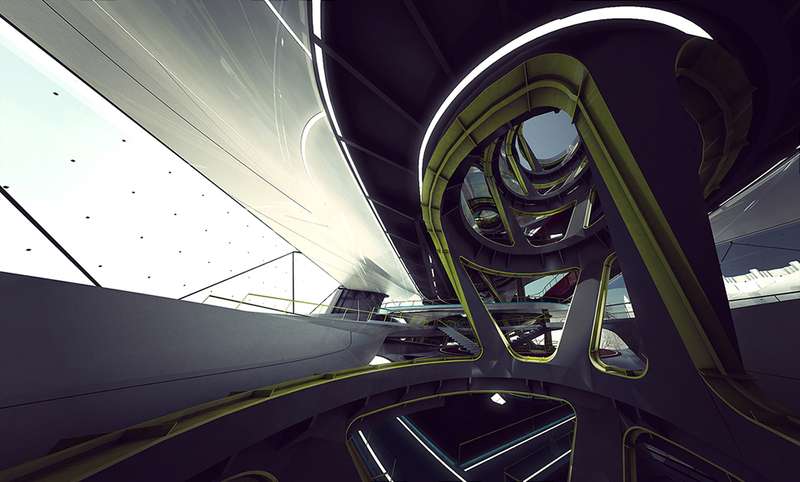
  • Amsterdam Workplace VI. Look up toward one of the 3 main int. voids.

    boston MASSACHUSETTS

    Harvard GSD

    critic: Ben van BERKEL

    suckerPUNCH: Describe your project.

    Yaohua WANG: VFX is short for visual effects. VFX industry is in a stage of its middle-age. It is younger than the mature and defined financial industries but older than the pimply and adolescent .com startups. At the moment, the middle-age VFX industry, is facing transitions.

    [MORE]

  • Driftbot
    san francisco CALIFORNIA

    California College of the Arts (CCA)
    critic: Jason K. JOHNSON

    suckerPUNCH: Describe your project.

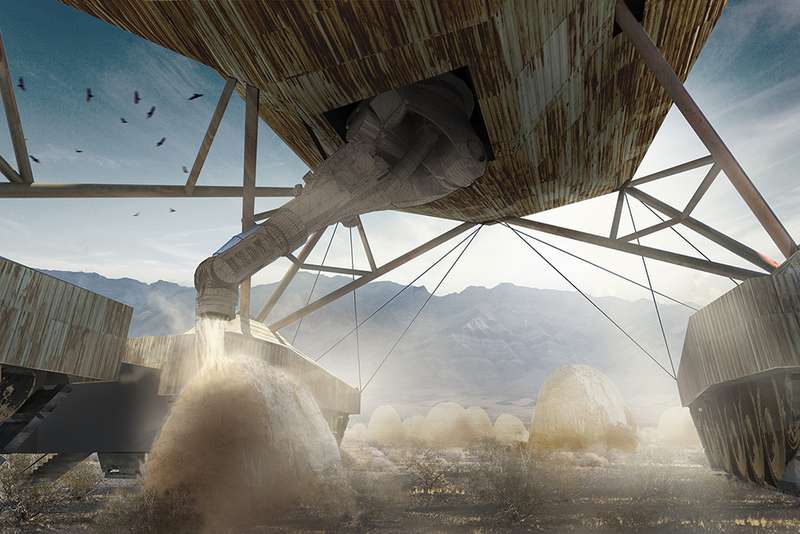
    Alex WOODHOUSE & Leah ZALDUMBIDE: Desert Driftbot investigates the prospect of an alternative, event-driven, nomadic society, fleeing the overbearing,cosmopolitan lifestyle of urbanity in favor of a simplified yet profound way of living. Seeking respite from a culture of extreme density, poor air quality, automotive dependence, materialism and ownership, this nomadic civilization has emerged in the barren desertscape of the Salton Sea.

    [MORE]


  • philadelphia PENNSYLVANIA

    University of Pennsylvania, PennDesign
    critic: Ali RAHIM

    suckerPUNCH: Describe your project.

    Yoonsun HWANG & Lois SOO KYUNG SUH: Hydropolis provokes the existing typology of a skyscraper set in the densest metropolis: Hong Kong. Accumulating diverse attributes of the city at multiple economic and social scales and translations, the tower yields transforming facade, structure and circulation system, from intricate to ludicrous. The project challenges the aggressive attitude of land reclamation by embracing the harbor front as a crucial part of the project, operating closely with water.

    [MORE]

  • New Atlantis (a city for voluntary exiles)
    brooklyn NEW YORK

    suckerPUNCH: Describe your project.

    Adam DAYEM: The year is 2100 and what was once called the nation of Kiribati is gone, its chains of low-lying islands have been completely submerged by the Pacific Ocean. Many I-Kiribati and their descendants have dispersed to Australia where they work in the health care industry or to New Zealand where they work as maritime shipping specialists. In these host nations, the I-Kiribati have become diffused. As a result, their culture and language has nearly died.

    [MORE]