




Ads
Ads

Ads

Ads

Ads

Ads

Ads

Ads


  • Experimental Architecture Biennial. Photo by Petr JEHLIK.
    prague CZECH REPUBLIC

    Experimental Architecture Biennial in Prague is an international platform for mapping the actual tendencies and architectural planning methods in reaction to a changing world of new philosophy and technology. It aims at re-emerging of interest in architectural thinking, transcending the closed borders of local critics´ standpoints. Volume # 1 EAB starts with 10 academic studios in Vienna, Insbruck, Bratislava and Prague, presenting new rising stars.

    Experimental Architecture Biennial
    exhibition: 04/26–05/26
    symposium: 05/22 (at Cinema Svetozor)
    Jaroslav Fragnera Gallery
    Betlemske namesti 5a
    Prague 1, Czech Republic

    [MORE]

  • Zaha Hadid Design, Zephyr Sofa by Cassina. Photo by Jacopo SPILIMBERGO.
    london UNITED KINGDOM

    The sinuous shape of the Zephyr sofa has been inspired by natural rock formations shaped by erosion: the application of subtractive processes that carve solid matter. The resulting formal language gives the Zephyr sofa increased ergonomic properties without compromising the design’s fluidity or proportion; translating into a concept that allows for multiple seating layouts. The carved profile incorporates deep backrests and generous undercuts for unrivaled comfort. A lacquered finish applied to Zephyr’s structural elements highlights every subtle nuance of its composition, and is contrasted by the tactile qualities of its bespoke upholstery and cushioning.

    [MORE]

  • Adaptive Ecologies: Notes on a Computational Urbanism
    london UNITED KINGDOM

    Architecture finds itself coping with new social and cultural complexities that radically re-factor and challenge its response through latent and often unknown parameters. Distinctions between information, matter and life reveal intricacies in the speculative realties of a much deeper synthesis. This symposium will open a discussion on the role of generative and behavioural approaches within the conception and production of contemporary architecture and urbanism.

    “Adaptive Ecologies: Notes on a Computational Urbanism”
    SPYROPOULOS, SCHUMACHER, RUY, FRAZER, STUART-SMITH, DILLON, & more
    Friday, 11/30
    10.00am–6.00 pm / Lecture Hall
    Architecture Association
    36 Bedford Square, London WC1B 3ES

    [MORE]

  • Eli and Edythe Broad Art Museum
    london UNITED KINGDOM

    The Eli and Edythe Broad Art Museum, located at the northern edge of the Michigan State University campus, is influenced by a set of movement paths that traverse and border the site. The vitality of street life on the northern side of Grand River Avenue and the historic heart of the university campus at the south side generate a network of paths and visual connections; some are part of the existing footpath layout, others create shortcuts between the city and the campus side of Grand River Avenue.

    [MORE]

  • National Stadium of Japan
    london UNITED KINGDOM

    Zaha Hadid Architects has won the international competition to build the new National Stadium of Japan. The practice, which produced the London Aquatics Centre for the 2012 Olympic Games, was selected ahead of 45 other international architecture firms for the US $1.62bn development.

    The announcement was made in Tokyo by celebrated Japanese architect Tadao Ando, who chaired the judging panel. British architects Richard Rogers and Norman Foster were also judges. Making the announcement Mr. Ando praised the fluidity and innovation of Hadid’s design and how it complements Tokyo’s landscape. “The entry’s dynamic and futuristic design embodies the messages Japan would like to convey to the rest of the world,” said Mr. Ando at a press conference on Thursday.

    [MORE]

  • Pleated Shell Structures
    los angeles CALIFORNIA

    This short term research-prototype posits itself within the argument for parametric design research to focus its efforts on design methods that encompass an operative pathway from design intent to its manifestation. Physical form-finding –hanging chains and cloth, soap films, etc.—and associated architectural design methods as pioneered by Antonio Gaudi, Heinz Isler, Frei Otto, Felix Candela and others is common knowledge among architects.

    Zaha Hadid Architects: Pleated Shell Structures
    Discussion & Opening Reception w/ Patrik Schumacher and Eric Owen Moss
    Friday, 10/12
    7.00 pm / W.M. Keck Lecture Hall
    960 East 3rd Street
    Los Angeles, California 90013

  • Why Bother?
    los angeles CALIFORNIA

    In spring 2012, the University of Applied Arts, Vienna, issued an international competition to overhaul the campus of the Angewandte, a group of buildings that house the University as well as the Museum for Applied Arts in Vienna, Austria. The competition became the center of a polemic debate marking both the end and beginning of an entirely different architectural landscape in the city of Vienna, the repercussions of which are still unraveling today. This symposium aims to discuss the architectural outcome and the political ramifications of the fragility of an intellectual project.
    [LIVE STREAM]

    “Why Bother,” Jeffrey Kipnis, Wolf Prix, and Patrik Schumacher
    Moderated by Hernan Diaz Alonso & intro. by Eric Owen Moss
    Thursday, 10/11
    7.00 pm / W. M. Keck Lecture Hall
    SCI-Arc
    960 East 3rd Street
    Los Angeles, California 90013

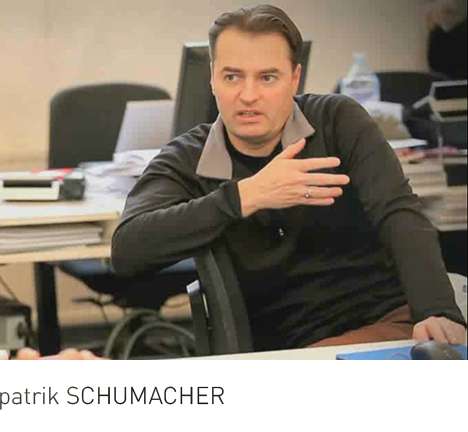
  • patrik SCHUMACHER
    los angeles CALIFORNIA

    Patrik Schumacher is partner at Zaha Hadid Architects and founding director at the AA Design Research Lab. In 1996, he founded the DRL with Brett Steele at the Architectural Association in London, and continues to serve as one of its co-directors. Schumacher’s contribution to the discourse of contemporary architecture is evident in his published works and interviews which can be viewed at his Web site.

    patrik SCHUMACHER, “Parametric Semiology”
    intro. by eric owen MOSS
    Wednesday, 10/10
    7.00 pm / W.M. Keck Lecture Hall
    SCI-Arc
    960 East 3rd Street
    Los Angeles, California 90013

  • Urban Field | Adaptive Urban Fabric
    innsbruck AUSTRIA

    suckerPUNCH: Describe your project.

    [uto] ursula FRICK & thomas GRABNER: Our modern times are unimaginable without planning. The growth of settlements and cities is so tempestuous that a slow process of adaptation is no longer possible. This, therefore, poses the question, whether by means of more adaptable planning theories, processes can be promoted or simulated which, seen as a whole, are “more natural”—Frei Otto (1)
    This work examines the thesis of Otto regarding the future direction of urban planning theory through the lens of parametric urbanism. The urban theory proposed translates the type of generating principles of the natural systems and unplanned settlements invoked by Otto, into a means of developing new forms of emergent urbanism.

    [MORE]


  • london ENGLAND

    The aim is a comprehensive theoretical system that offers itself to architecture as its comprehensive self-description describing architecture from within architecture, in its internal constitution, and in its relationship to its societal environment. The premise here is that architecture has always already constituted itself self-referentially, via its own autonomous, disciplinary discourse.
    The theory proposed here, the theory of architectural autopoiesis, focuses on architectural communications and “observes” these communications to detect its typical patterns. The theory analyses how individual communications depend upon and reproduce communication structures like the key distinctions, concepts, values, styles, methods and media of the discipline.